
Did Bazball Spoil Root?

Joe Root is not a Bazballer. He’s a fabulous player but he’s been sucked into a game that doesn’t suit everyone, and it doesn’t suit Joe. Reverse sweeping, ten minutes into day three to the best seam bowler in the world, fraught with danger - come on!
This is what Phil Tufnell said after Root attempted to reverse scoop Bumrah. In fact, this is what everyone has been saying since Root played that dreaded reverse scoop. But what does the data say? Has Bazball really spoiled Root?
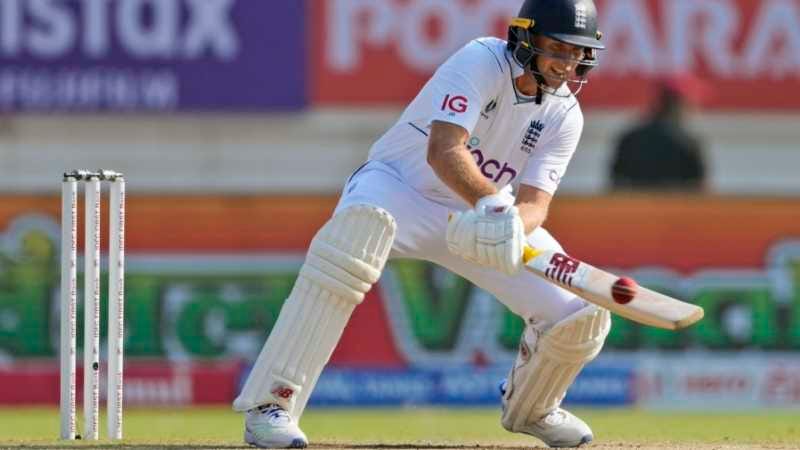
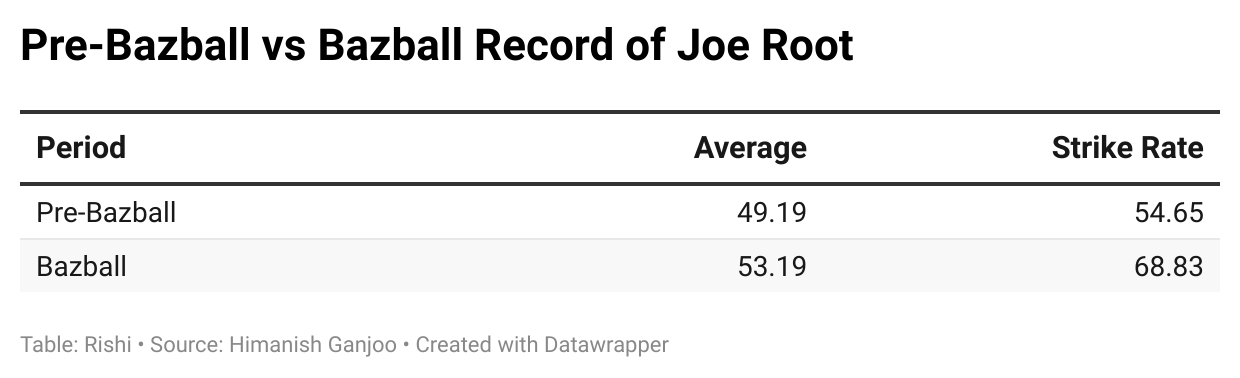
large section of cricket fans agrees with Tufnell that Bazball doesn’t suit Root, arguing he should stick to his old conventional style. Bazball enthusiasts counter this by highlighting Root’s higher average during the Bazball era. He indeed averages 53.19 in the Bazball era compared to 49.19 previously.
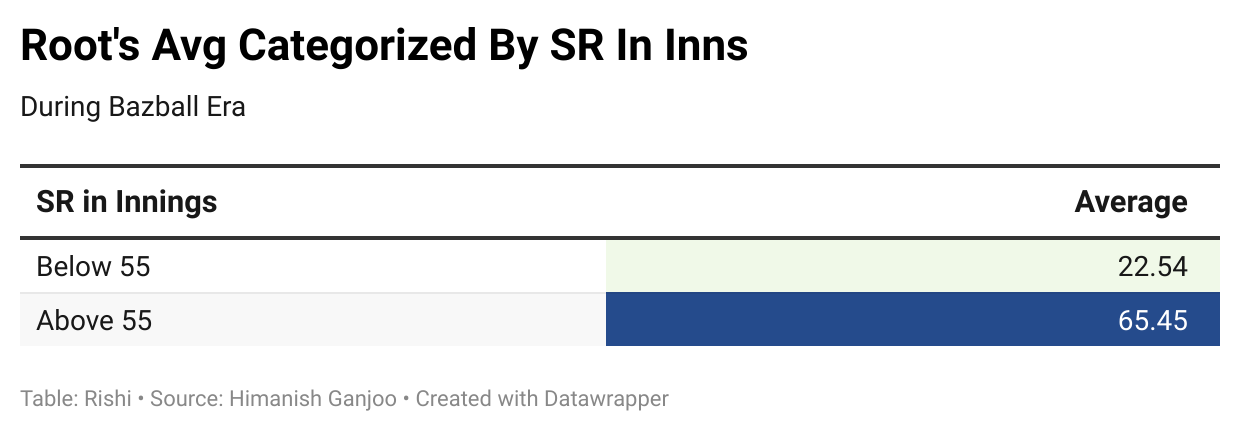
In fact, during the Bazball era, Root has a higher average in innings where he has a higher strike rate. His average in innings with a strike rate above 55 is 65.45, while it drops to just 22.54 in innings with a strike rate below 55.
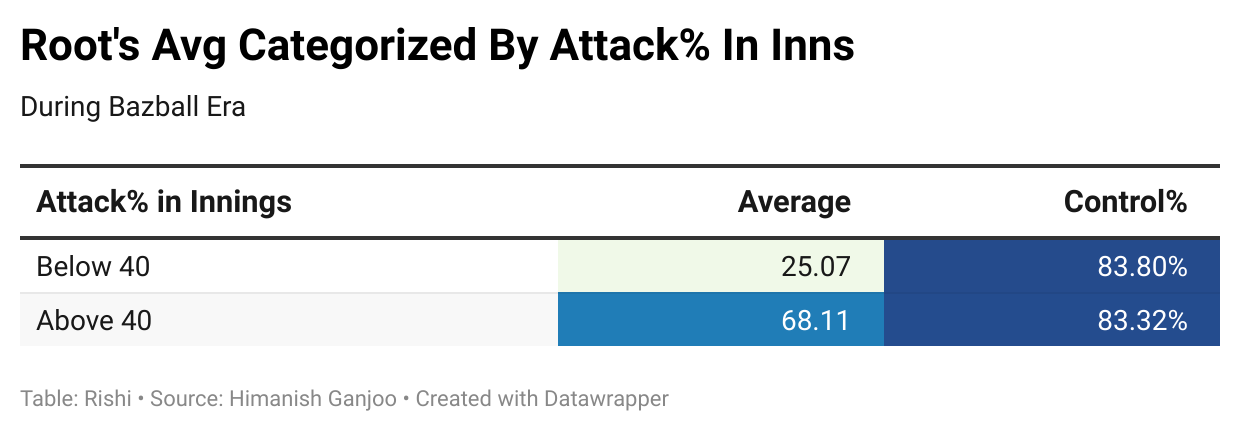
However, strike rate may not be the best metric. Instead, let’s use attack% which helps us accurately determine how attacking he was in each innings based on shot type data.
But guess what, the observations show no noticeable difference. Root has certainly performed better in innings where he attacked more.
You could argue that the final attack% is also not a reliable measure, as he might have started slow and then accelerated after reaching a milestone, as batters often do. To verify this, let’s just consider Root’s attack% in the first 50 balls of all his innings during the Bazball era.
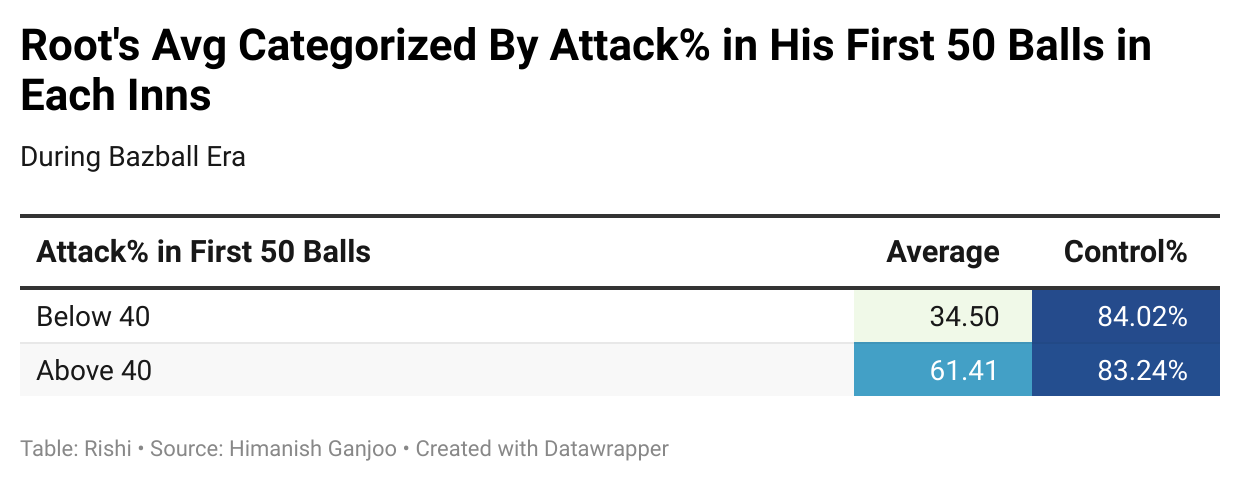
Sorry Bazball-naysayers, but here’s more bad news: he still has a better record when he attacks more.
While analyzing only the first 25 balls adds an interesting perspective, it still doesn’t provide any support to the argument that Bazball has diminished Root’s returns.
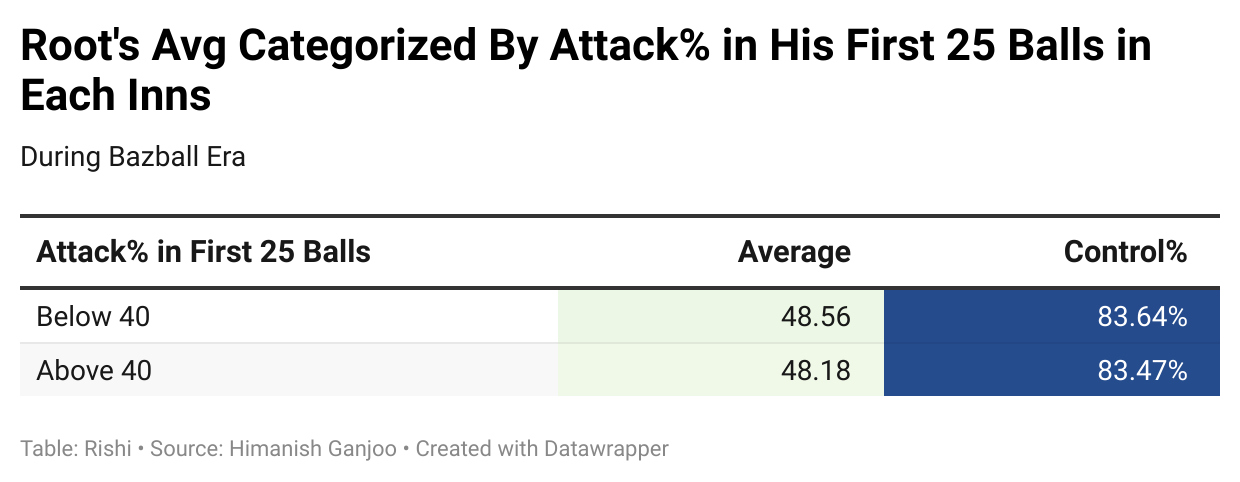
Alright, now let’s talk about something which I’ve deliberately set aside but have clearly presented for you all to see - his control%. Notice how his control% remains remarkably consistent regardless of how attacking he is. Even during his pre-Bazball days, when his overall attack rate was 39.17%, his control rate was 85.68%, which isn’t significantly different from the numbers mentioned above. Conventional knowledge suggests that you have to compromise your control% to achieve a higher attack%. So, how does Root manage to maintain his control% while being more attacking? It could potentially explain why Bazball hasn’t affected his record.
To find out, let’s break down shot type data further and examine the shots Root has played. The key observations are presented in the table below:
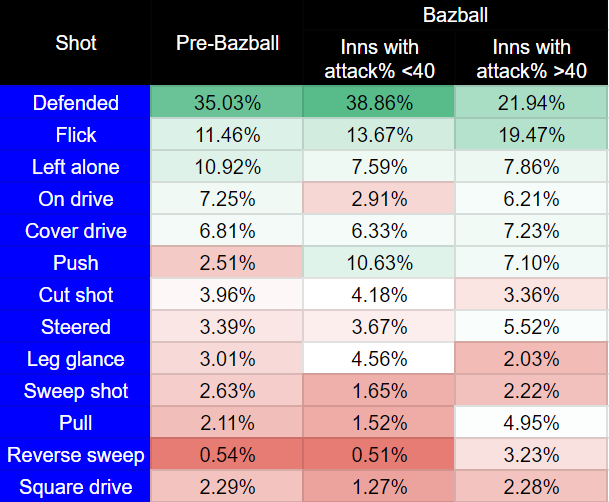
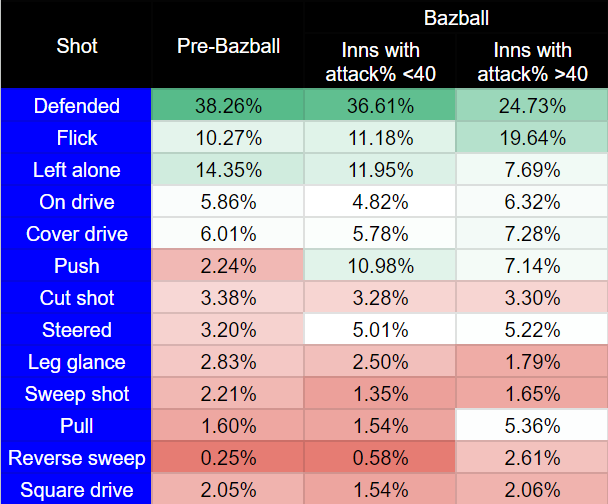
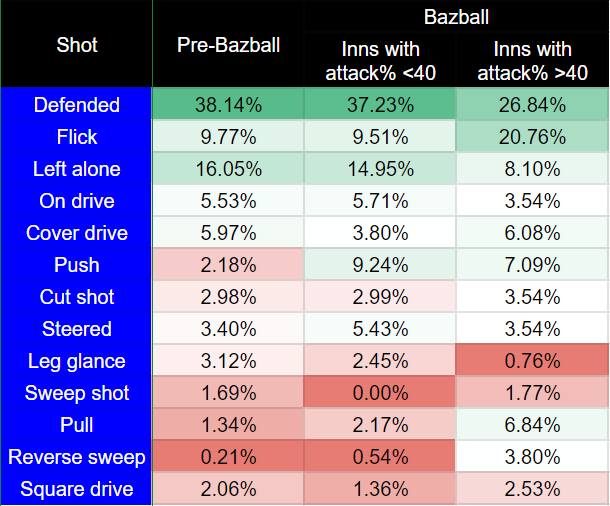
The above table helps us understand the changes in Root's shot selection when he adopts a more attacking approach. You can see that he defends and leaves the ball less, while he has started flicking, pushing, steering, pulling, and reverse sweeping more in the Bazball era. Some shots, like the cut, sweep, and square drive, remain at similar percentages as before. But what you’re about to see next is what’s going to explain Root’s genius.
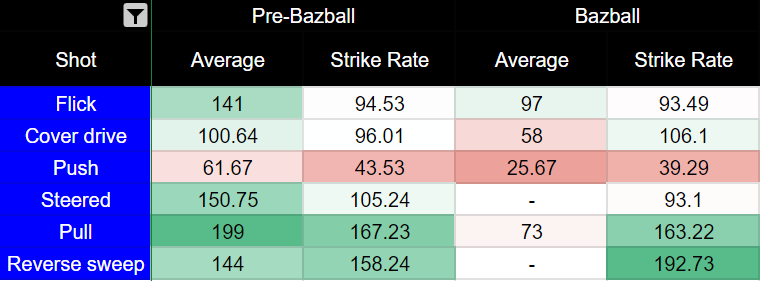
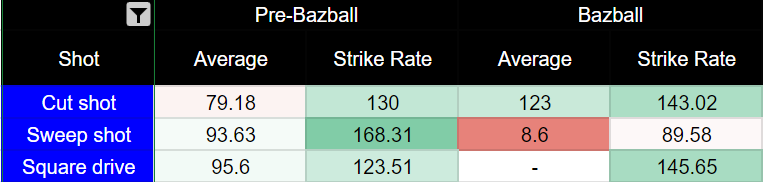
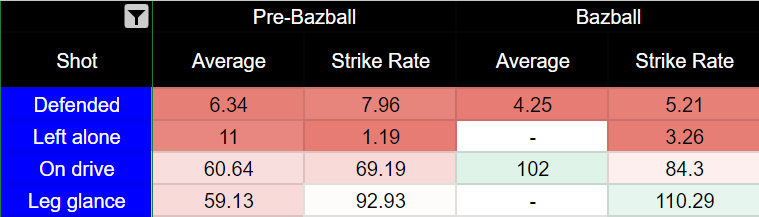
You'll notice that most of the shots Root plays more in the Bazball era are ones that have given him good returns in the past. The shots he plays less are those that didn’t yield good returns, while the shots he plays the same amount provided moderate returns.
Bazball is often associated with reckless hitting among the general public but Root has been fantastic with his shot selection. Yes, he has been more attacking but he achieves this by playing his most productive shots more often and his less productive shots less often. This could also explain how he maintains his control% despite being more aggressive. He only plays his comfortable shots more often and isn’t really trying to do something he can’t. In fact, the reverse scoop, which has drawn a lot of criticism, accounts for only 0.17% of his shots during the Bazball era.
His shot selection has changed similarly in his first 50 balls and first 25 balls.
Now that Bazballians have enough to be over the moon, let’s bring them back to earth by asking the important question - Is Bazball solely responsible for Root’s improved record?
Yes, Root has a better record during the Bazball era but it would be too simplistic to conclude that his better record is solely because of Bazball.
There was a one-and-a-half year period, just before Bazball, when Root significantly upped his game. During this period, his average was 54.36, compared to 47.99 before. His attack% also increased to 42.57% from 38.22%. To provide more context, his attack% during the Bazball era is 45.97%. The increase in his attack% was more pronounced in this interim period than after Bazball took over.
And the way his shot preferences changed during this transformative period looks familiar.
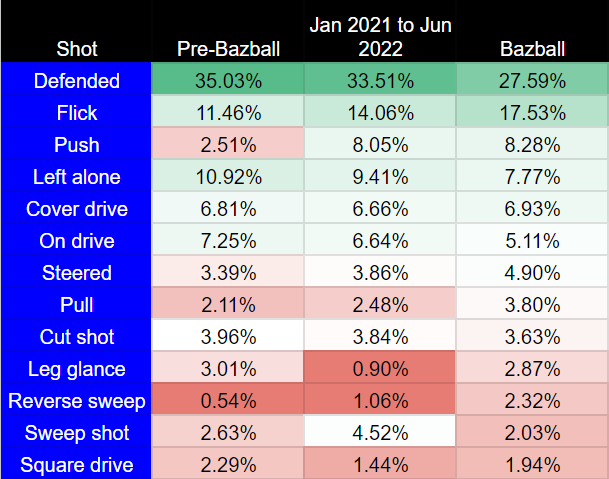
Notice how there is a progressive increase or decrease in each shot he plays. Root had already begun to adopt a more attacking style before Bazball. Although he became even more aggressive during the Bazball era, it wasn’t a sudden shift as often portrayed. He had identified his most productive shots even before Bazball and had started playing them more frequently.
The article started by discussing Root’s reverse scoop against Bumrah. That one dismissal influenced perceptions so much that people began believing that’s how he plays in the Bazball era. In reality, he’s been very clever in choosing which shots to play more aggressively. On the other hand, it would be disrespectful to someone of Root’s class to simply attribute his improved record to Bazball. He started becoming more aggressive before Bazball, and Bazball just acted as a catalyst to accelerate this further. Bazball neither spoiled him nor deserves sole credit for his success. Instead, Root should be celebrated for finding a way to make such an extreme approach work for him.
All stats presented in this article are accurate as of July 12, 2024.
Stats credit: Himanish Ganjoo