
IPL MVP

My articles usually start with a random quote or incident, but this time I’ll begin with one of my own tweets.
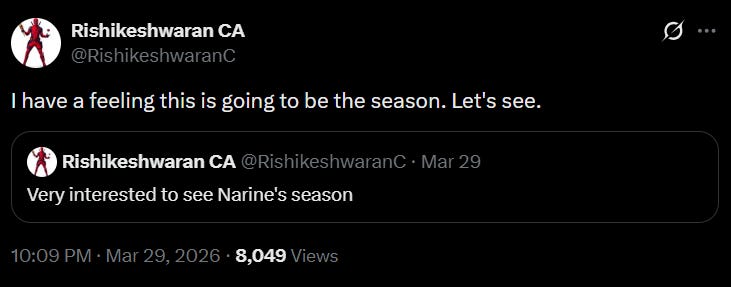
I expected this to be the season where Sunil Narine would finally be taken down by batters and his stock would start falling. My rationale was simple: he’s aging, the margin for error has been consistently shrinking for spinners and T20 batting standards are at an all-time high. I couldn’t have been more wrong about Narine though.
Narine’s T20 record has always felt like an aberration. Although he isn’t as much of a wicket-taker as he was in the early part of his career, his economy rate consistently remained elite. There has been only one year where his T20 economy rate went above 7 and even then, it didn’t cross 7.5. Even in the IPL, the toughest T20 league, his economy never touched 8 in any season.
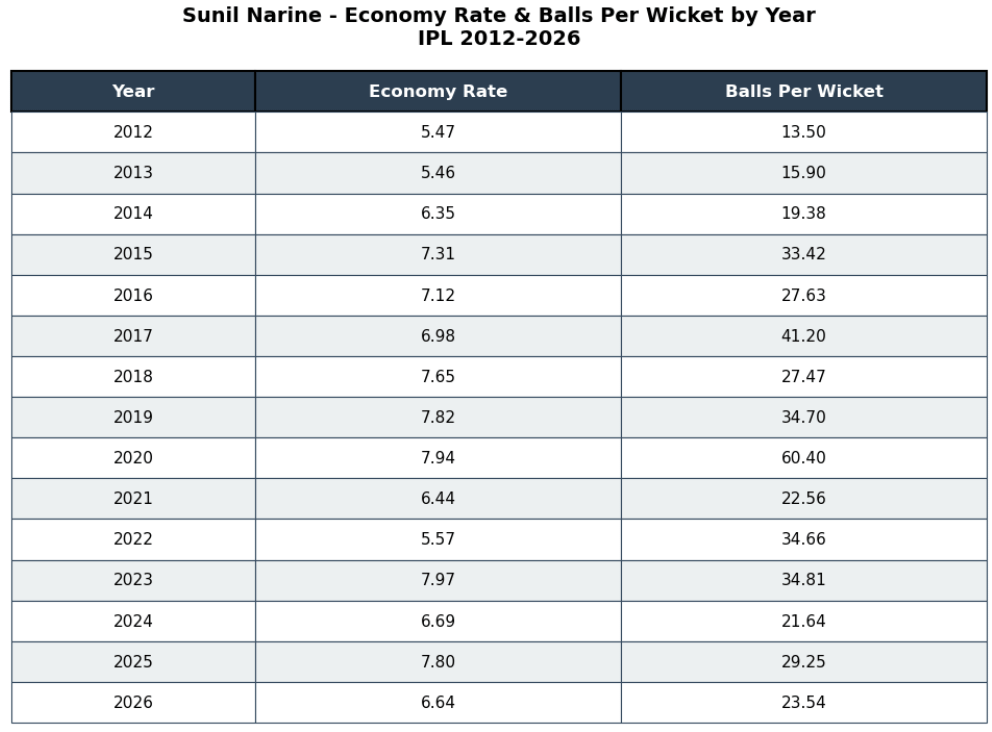
T20 has evolved a lot since the start of his career. Strategies changed, power hitting evolved, phase specialists emerged, quick spinners took over, analytics advanced, batting went through another stage of evolution and bowlers are now left with little margin for error. Even Rashid Khan, who took the T20 world by storm and emerged as the world’s best spinner, couldn’t escape the tide. But Narine keeps going.
What’s remarkable is that his economy rate holds up across all phases.
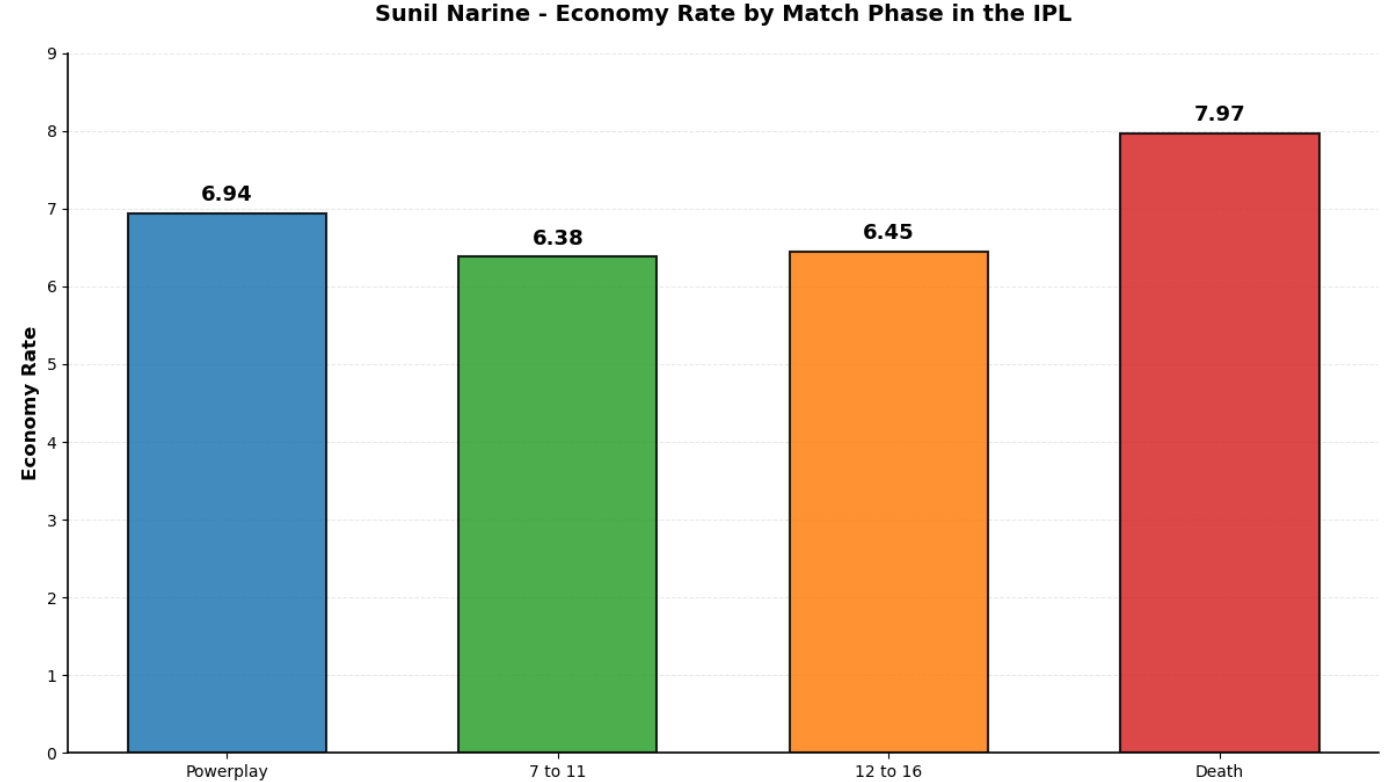
Yes, his powerplay and death economy rates have crossed 8 in recent years but that’s simply an effect of batters levelling up. He’s still better than other spinners.
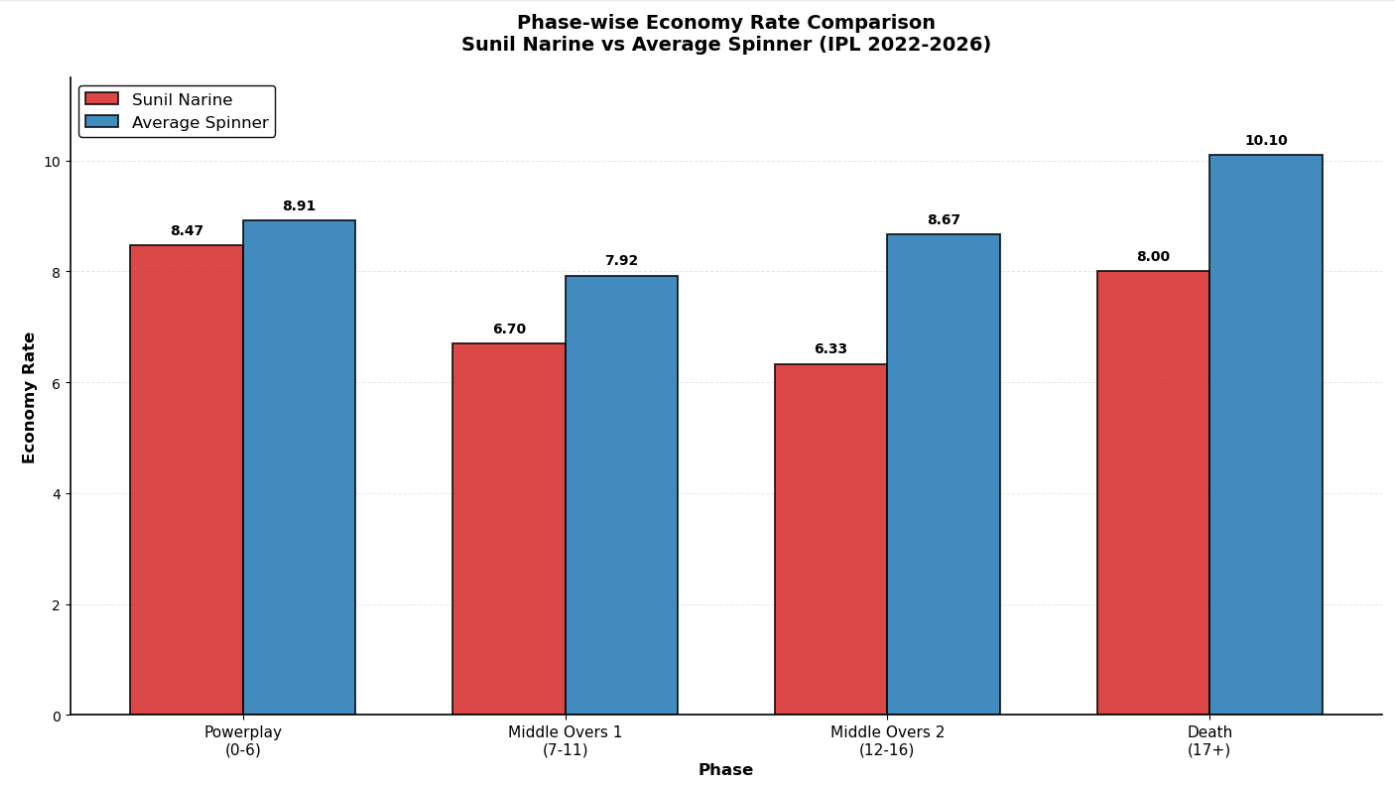
Among spinners who have bowled at least 15 overs at the death in the IPL, Narine has the best economy rate. It would be safe to say that Narine is the best-ever defensive spinner in T20 cricket. That is reflected in how teams are willing to bowl him at the death and in super overs. He maintains his exceptional record after bowling 127 overs at the death while no other spinner has bowled even half that many. We often see newer cricket stats enthusiasts bringing up the fact that spinners have better death over records. Narine’s contribution to that record is significant.
Modern day T20 cricket has made the equation simple for spinners. Simple, for us viewers, but difficult for the spinners themselves. One non-negotiable to maintain a good economy rate is to land the ball in the 5 to 7 metre length. The defensive-good-length and short-of-good-length are the only two lengths where spinners aren’t travelling.
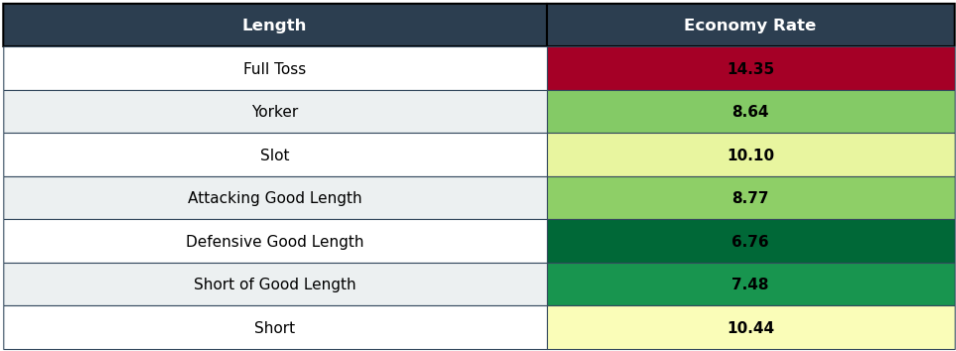
Maintaining such a high level of accuracy is not easy but Narine has been doing it for years. His length distribution curve looks exceptional and shows how incredibly consistent he has been at landing the ball on those defensive lengths.
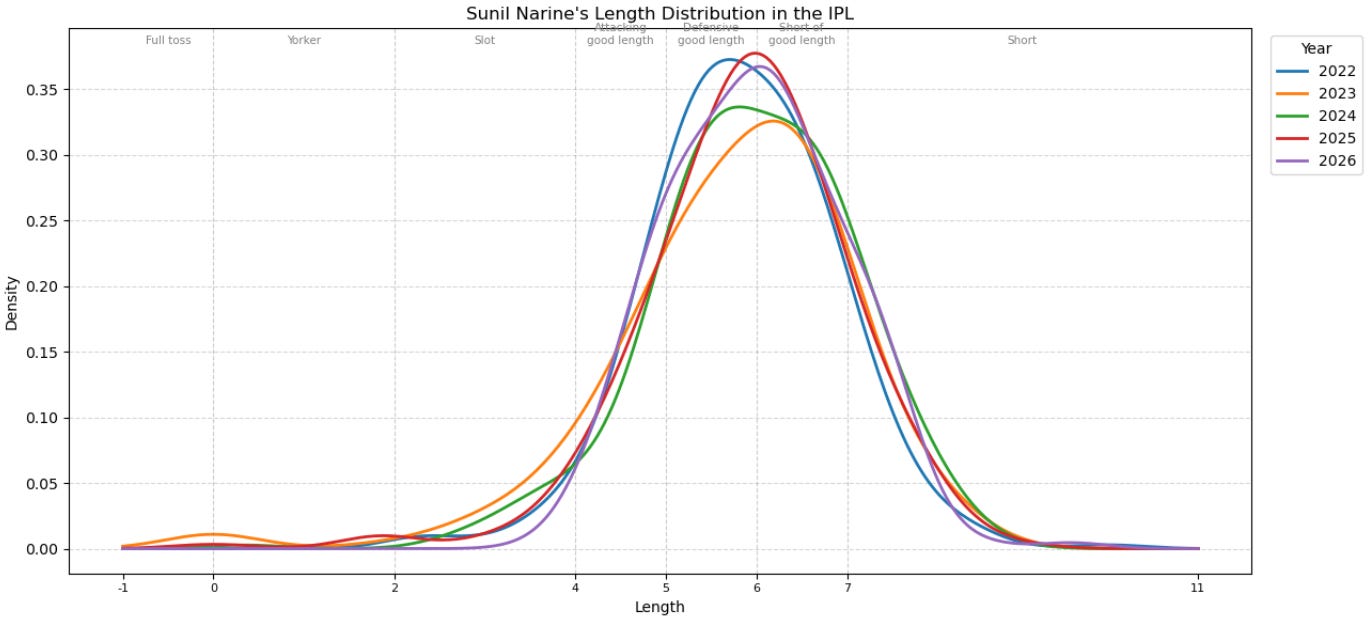
Since 2022, at least 65% of Narine’s deliveries have landed in the defensive-good-length or short-of-good-length zones every IPL season. Even when he misses those lengths, he predominantly hits the next-best length - the attacking-good-length, which is also optimal for wicket taking. Only in the 2024 season did more than 20% of his deliveries land outside the good and short-of-good-length zones.
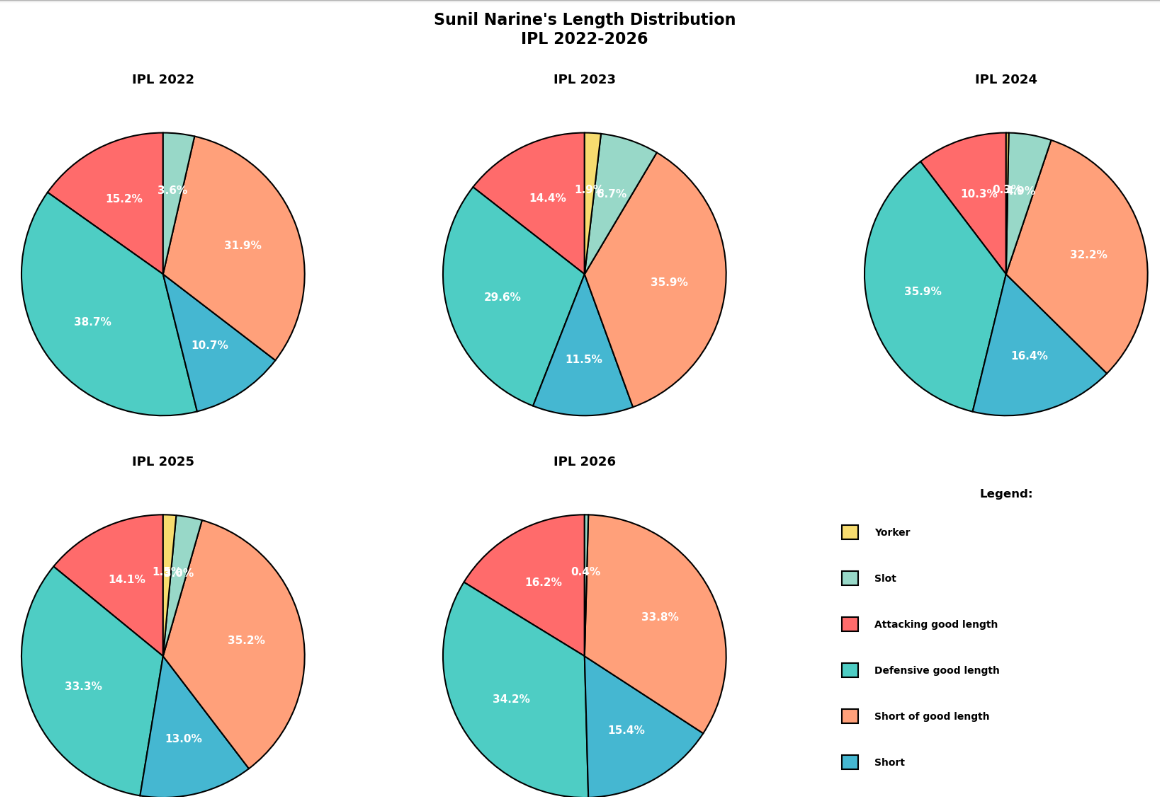
His elite accuracy isn’t just limited to the lengths he bowls. His line distribution curve shows how consistently tight his lines are.
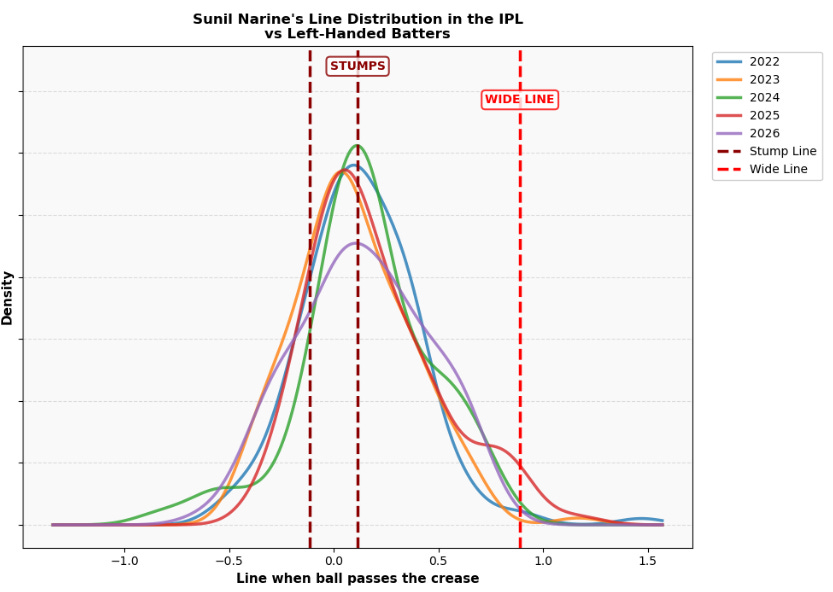
Consistency is not the only thing Narine excels at. He can also turn to variations when needed. Although Narine isn’t a big turner of the ball, it’s well known that he can turn the ball both ways.
The ability to turn the ball both ways has become a vital weapon for spinners in T20 cricket. A smart enough spinner can use that ability to be unpredictable. 91.86% of Narine’s overs contained balls turning both ways - fifth highest for a spinner in the IPL since 2022.
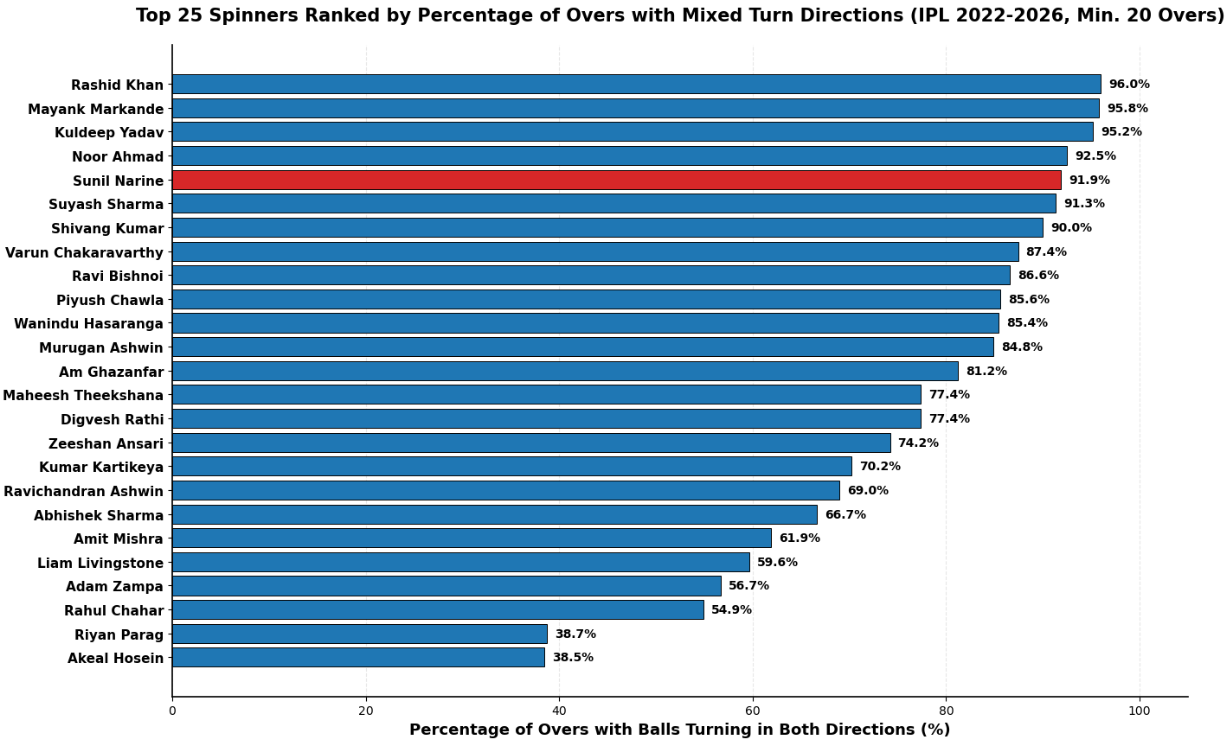
But this metric isn’t perfect. What if he bowls five balls turning one way and only one the other way? He’d still be fairly predictable right?
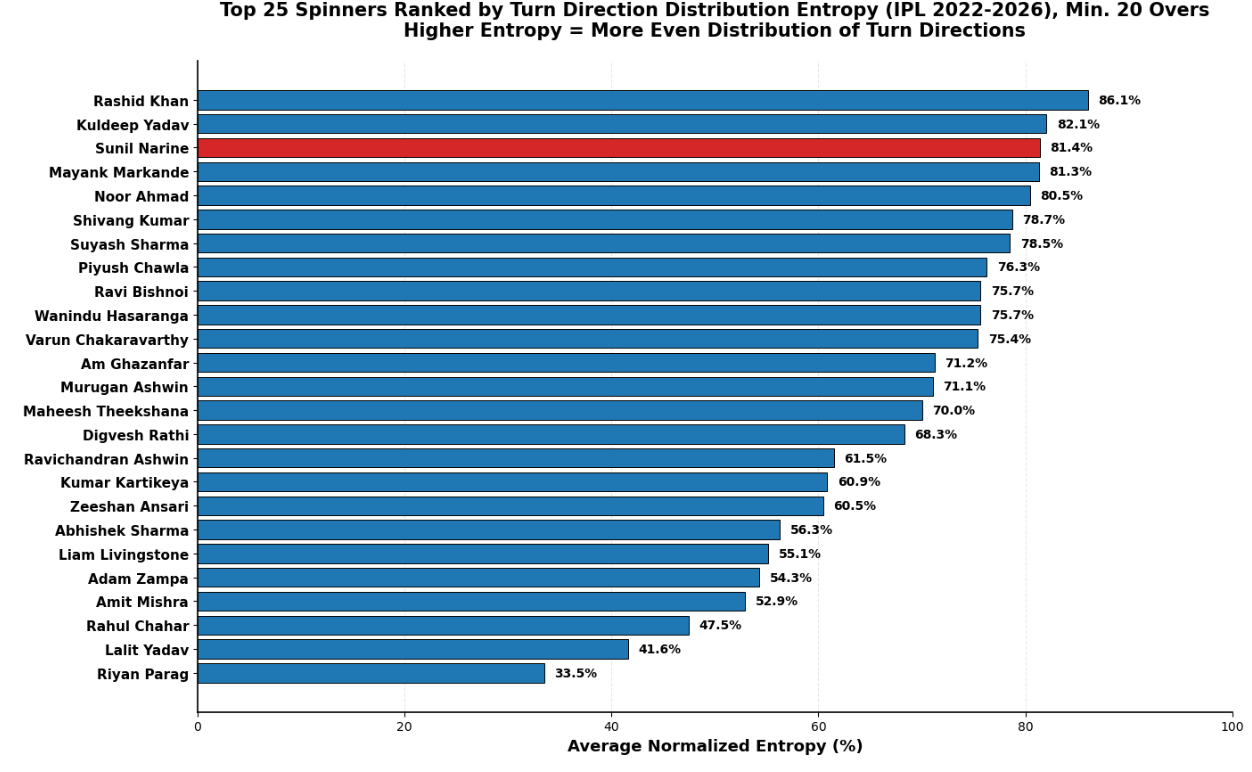
Entropy is a measure that can be used to capture how well a spinner mixes up his turn directions. It measures how evenly spread out the turn directions are in an over. A bowler who turns only one ball in a different direction will have low entropy. A bowler who turns three balls one way and three the other will have high entropy. Narine is among the best by this metric too.
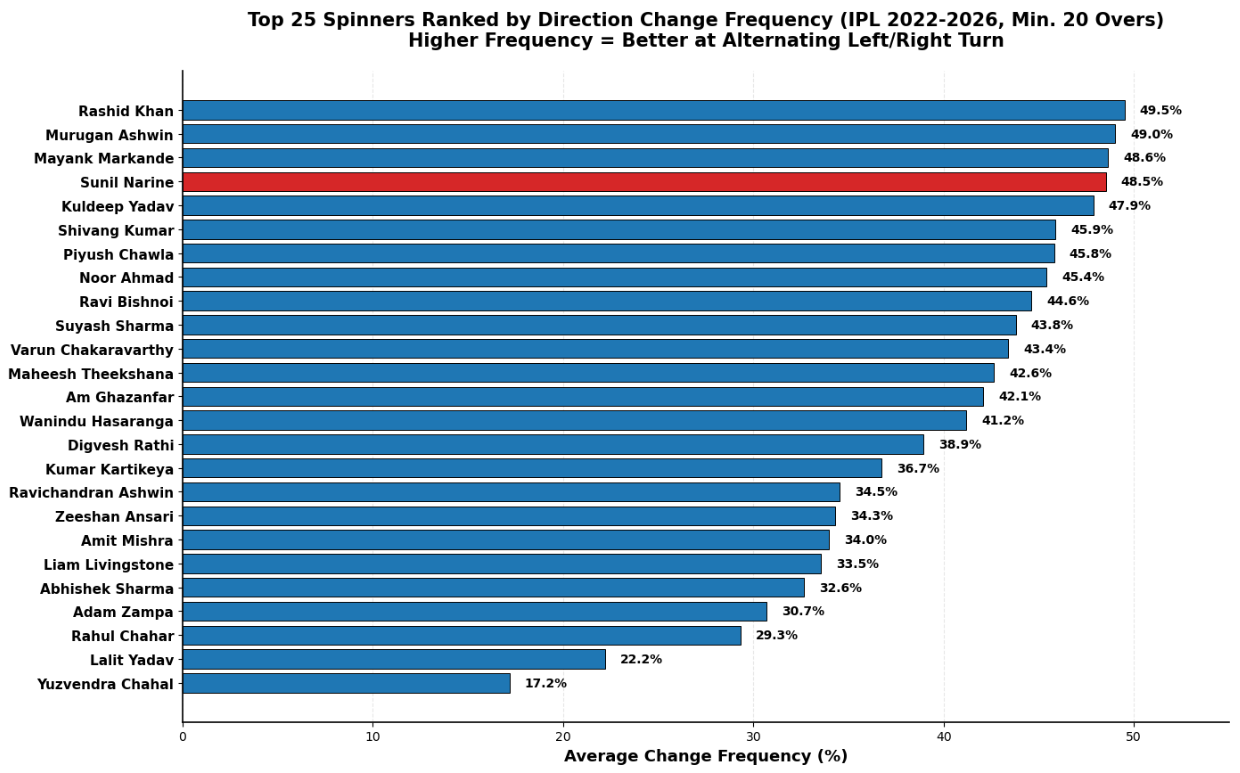
Further evidence of his unpredictability is how frequently he varies his turn direction between deliveries. Change frequency measures how often the bowler changes direction from one ball to the next within an over. A higher value indicates better mixing.
The variations don’t end with turn directions. Narine is also good at varying his pace.
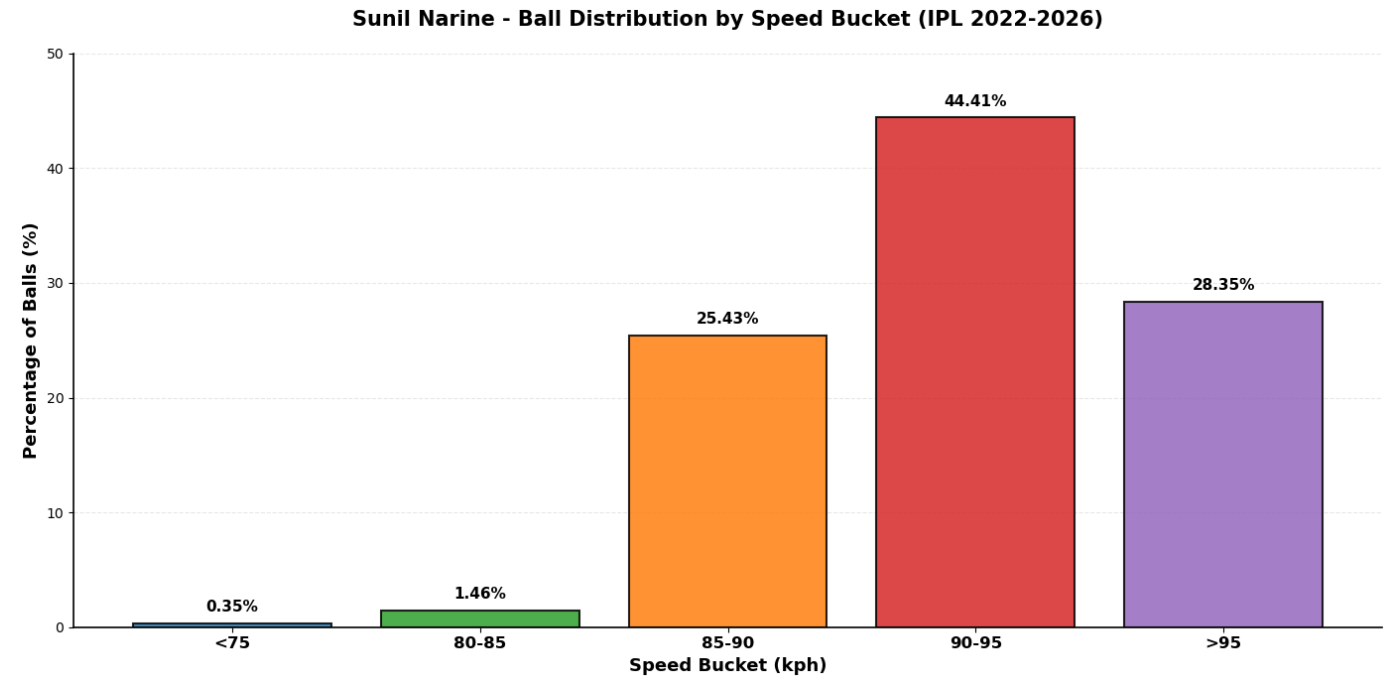
Narine has bowled at least 20% of his balls in three different speed buckets in three of the last five IPL seasons (2022, 2023, and 2026). Apart from him, only two other spinners have achieved this - Rashid Khan and Axar Patel.
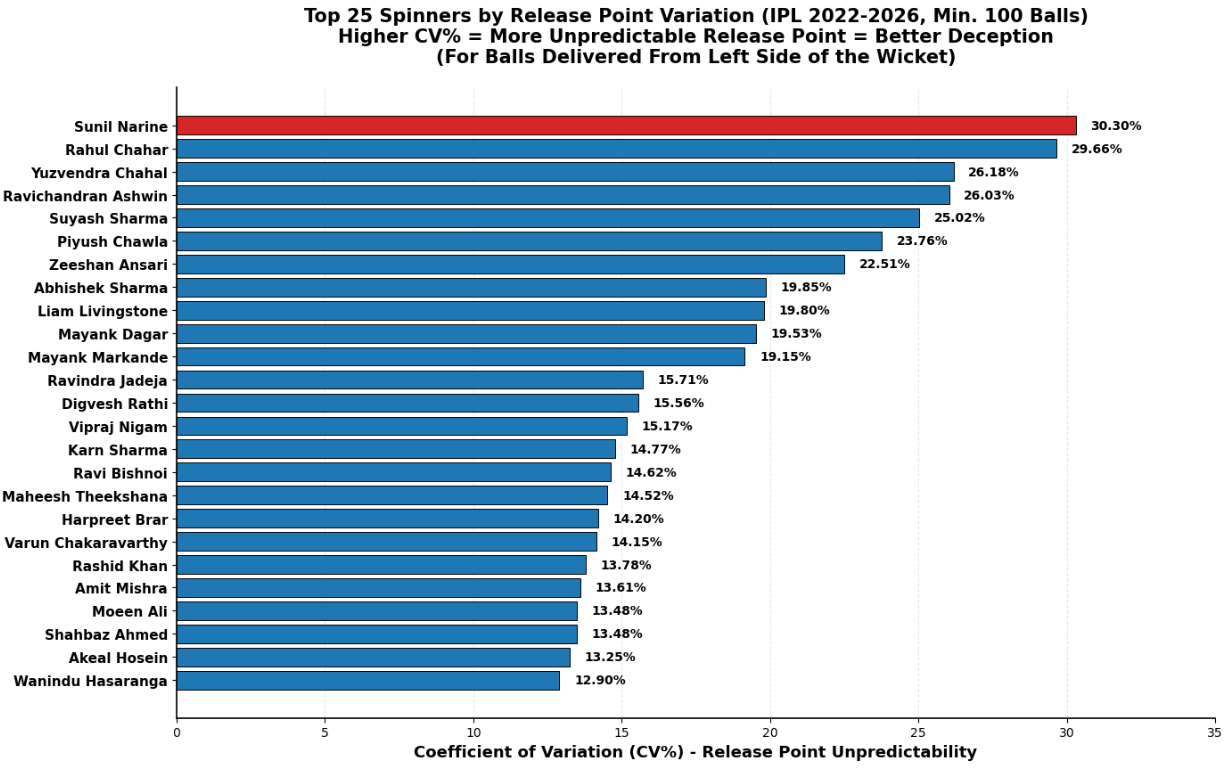
Narine doesn’t just vary his revs and release speed, he also varies his release point. When bowling from over the wicket, his release lines span a wide range.
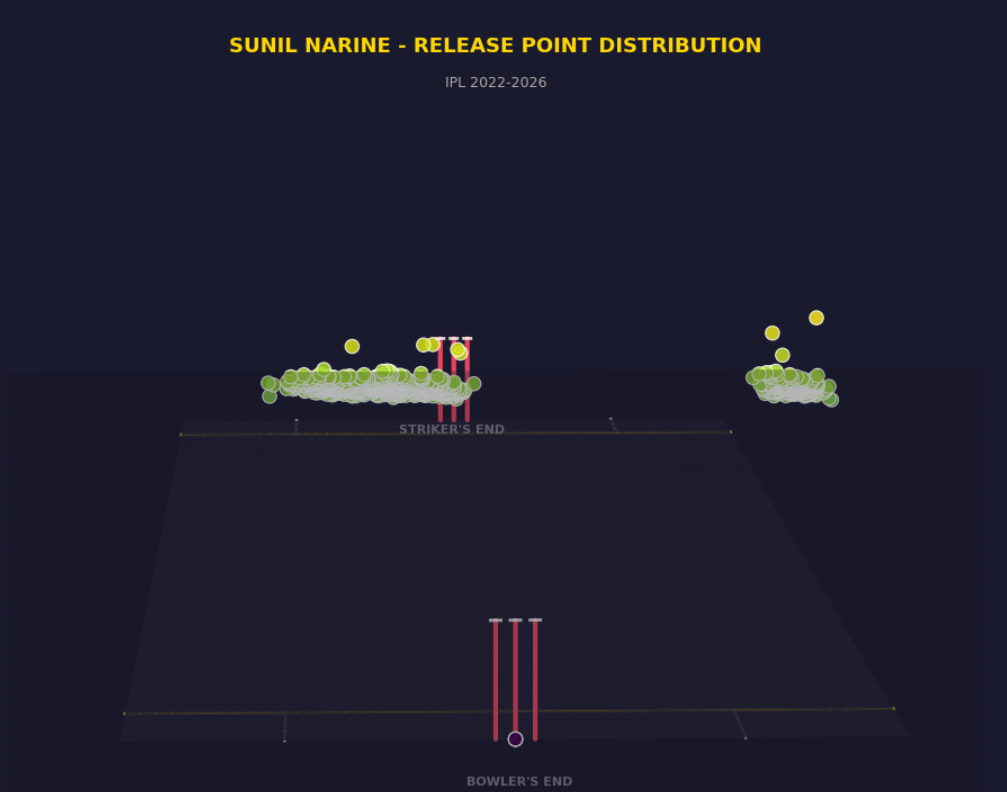
Coefficient of variation quantifies how much a bowler’s release point typically deviates from his mean release point. Narine has the highest coefficient of variation among all spinners when bowling from the left side of the stumps.
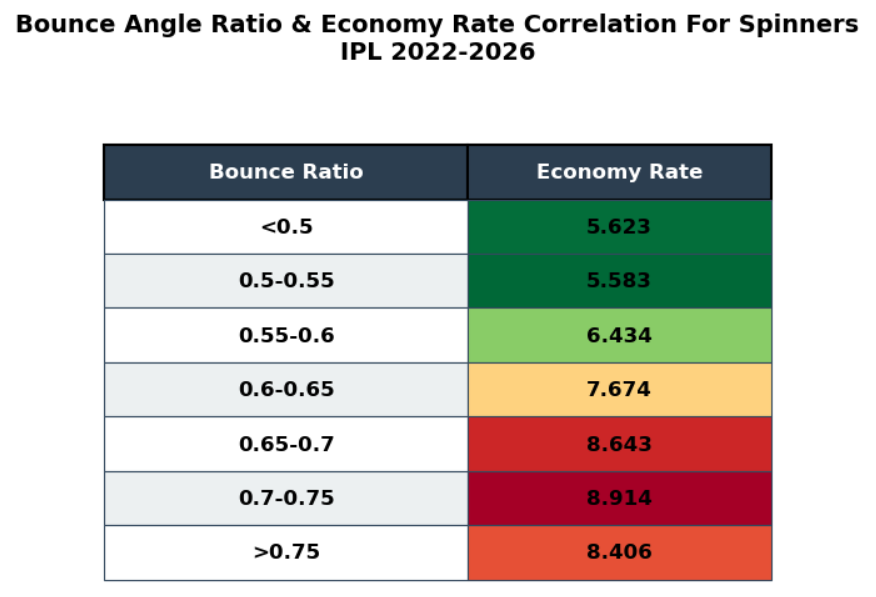
Another metric where Narine shines is the bounce angle ratio, which I touched on in my previous article (I’m not explaining it, go read the full article hehe). Narine has the lowest bounce angle ratio among spinners in the IPL.
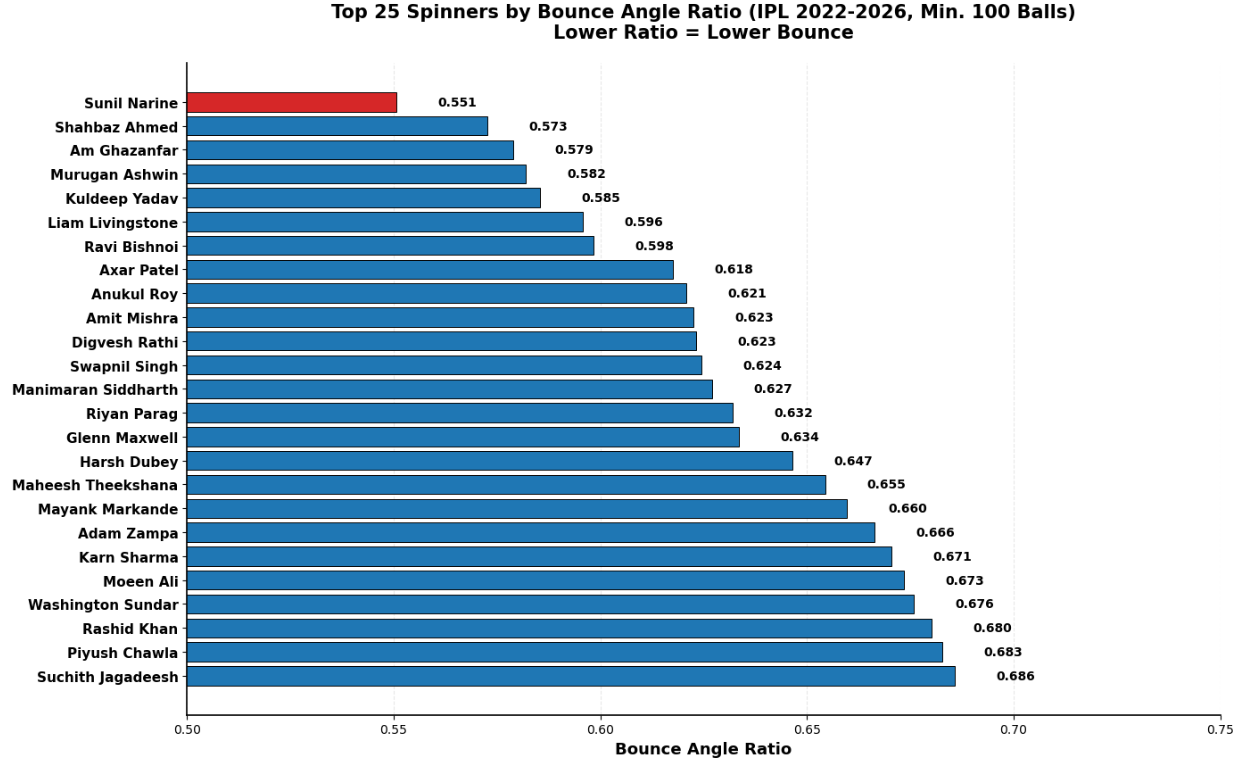
This matters because a lower bounce angle ratio correlates with a lower economy.
All of this points to how much of a master craftsman Narine is. Some bowlers excel at consistency. Some bowlers excel at variations. Narine is consistent in the attributes that reward consistency and varied in the attributes that reward variation. And he’s among the best in each.
Having said all that, I cannot conclude this article without talking about the elephant in the room - his action.
Narine’s bowling action has been a subject of controversy for a long time now. He has been reported for illegal action in the past and has even remodelled his action multiple times, yet the doubts still persist among the masses. While I have my own opinions, I feel it wouldn’t be fair to take any side without presenting data and evidence to support my stance. But the disregard of this matter by those who have the data has been intriguing.
Like how quickly the MCC jumps in with an explanation every time there’s a controversy surrounding the laws of the game, it shouldn’t be too difficult for the administrators to provide evidence and settle the debate, whichever way the evidence points. It would be a shame if a career as extraordinary as Narine’s is always remembered with an asterisk. But regardless of where you stand, you cannot deny how incredibly skillful Narine is. Legal or illegal, nobody else could replicate what he has done over a long career. The air will clear at some point. Until then, Sunil Narine is a T20 legend. Sunil Narine is the IPL MVP.
All stats presented in this article are accurate as of May 14, 2026.
Stats & Data credit: Statsguru, Cricmetric, iplt20.com, Adithya Balagoni (@TechRadar9 on Twitter) and Himanish Ganjoo
A few days back, I wrote a post on him on X highlighting his long IPL career. The league has transformed, and the standards are much higher. The margin for error for bowlers, especially spinners, is very small. Narine has played it smart all this time, and his economy rate is still lower than that of other spinners. His effectiveness and wicket-taking ability declined after changes in his action and a shift in the batter's approach against him, but Narine always worked around them. He also worked on his batting in the meantime, thereby adding more value to his game. He is the only foreign player to have 200+ IPL wickets and a century (something not even his teammates at TKR, Pollard and Russell have). No wonder he is a real MVP, and KKR ensures that he is retained all these years.