
Slow Ball Merchants

Lungi Ngidi runs in from round the wicket and releases the ball. Nicholas Pooran has tracked it to be a perfect stump line yorker. He brings out his backswing and appears prepared to dig out the yorker, perhaps to mid-off for a single - the perfect response to a perfect yorker. Suddenly something weird happens - the ball changes course and drops down violently and lands a touch shorter than the yorker length it initially promised to land on. Pooran is confused. He loses balance and his bat moves away in a weird angle. None of it matters though - the ball goes through the gap between the bat and pad and shatters the stumps.
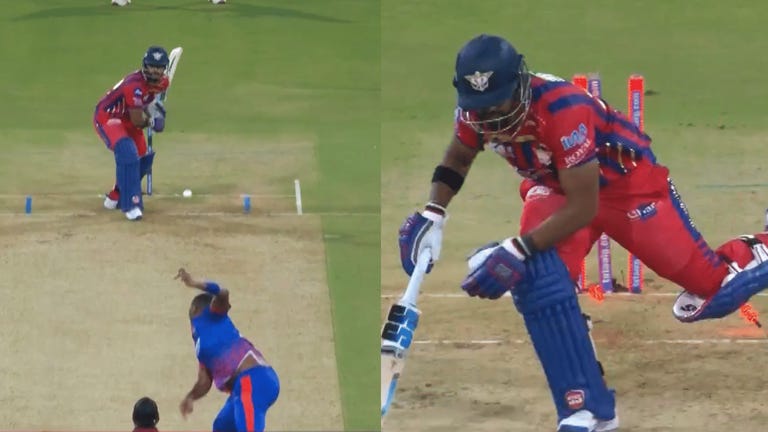
This is the dipping Ngidi cutter that has been flummoxing batters for a while now. Ngidi is a slow ball merchant. 55.41% of his deliveries in IPL 2026 have been clocked below 128 kph. But is that enough to call him a slow ball merchant?
The term has had an interesting journey in T20 cricket. Initially it was used for a niche variety of seamers who were slow ball specialists, using the slower delivery as a weapon. Later it took on a derogatory connotation when some bowlers started overusing it to the point where it was no longer a weapon and became easy for batters to hit. Still, the tag belonged to only a small subset of bowlers.
Today, T20 cricket has entered a different age. Plotting the pace distributions of seamers and identifying those with a bimodal graph was a thing a few years ago. Now we live in a bimodal world. All seamers in the IPL have a bimodal pace distribution curve. It’s no longer a specialist skill, every seamer bowls a slower delivery. So how do you define a slow ball merchant these days?
I’ll leave that part to you because all these semantics don’t really matter. What matters in today’s T20 world is how effective your slower ball is.
Slower balls are interesting. Although the unpredictability of a slower ball can surprise batters, it remains effective only as long as it is unpredictable. If the batter knows it’s coming, it’s just another ball with an added advantage of more time to react.
Data shows that the slower you bowl, the higher the scoring rate.
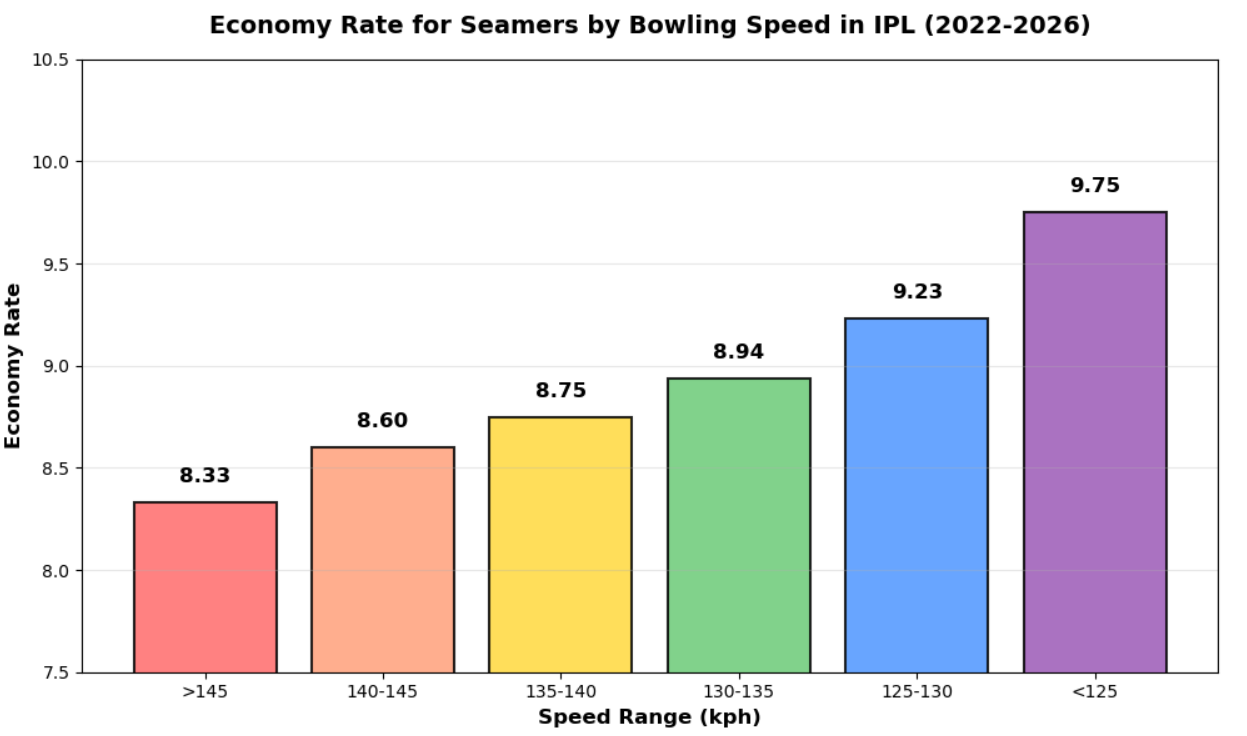
In an increasingly fast-scoring T20 era, effective bowlers are those who can deliver a slower ball yet still manage to keep the run rate in check.
For this analysis, we’ll define a slower ball as any delivery bowled by a seamer at less than 128 kph*.
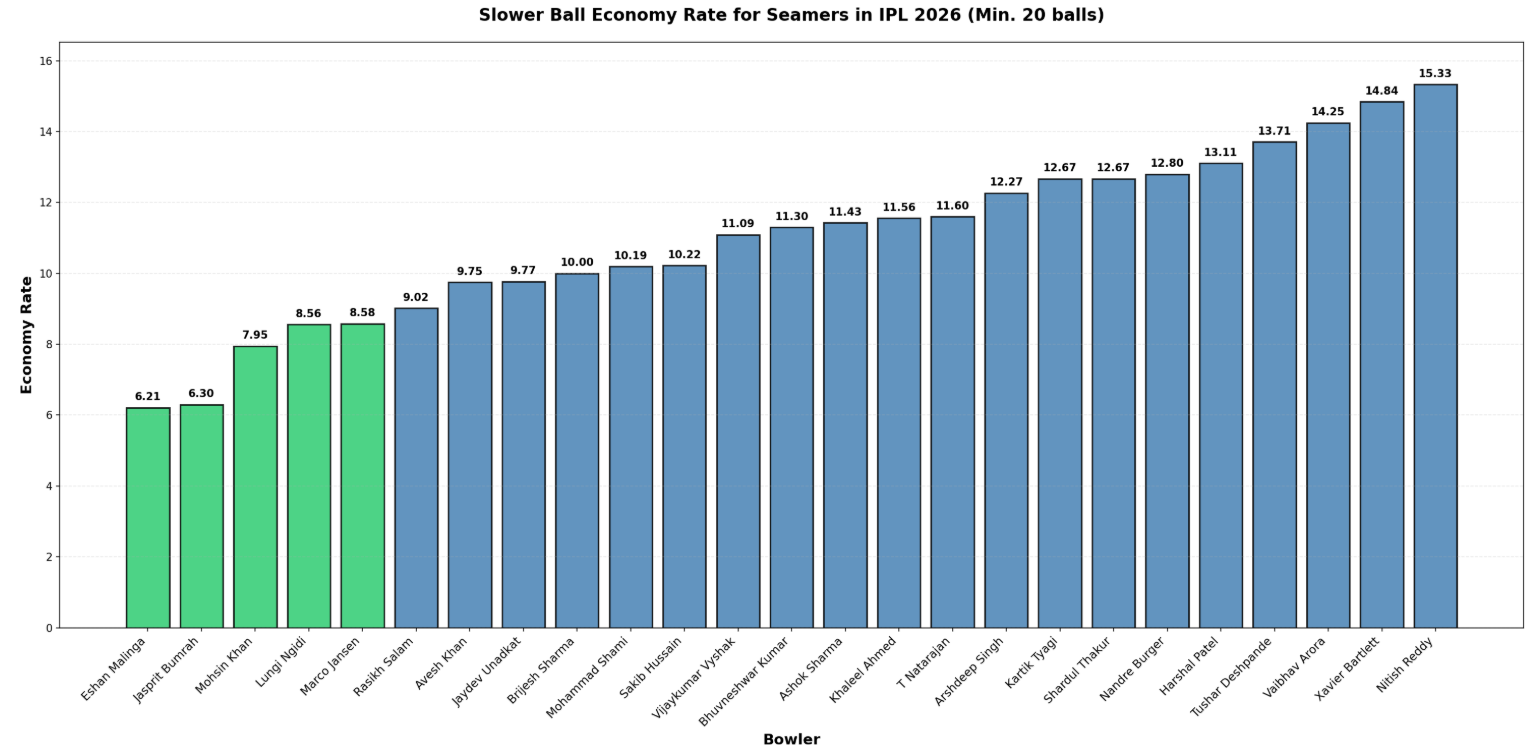
In IPL 2026, five bowlers have an economy rate below 9 while bowling slower balls: Eshan Malinga, Jasprit Bumrah, Mohsin Khan, Lungi Ngidi and Marco Jansen.
Unlike other strategies, there’s no optimal way to execute a slower ball. You can really customize it to your strengths and still be effective. The fascinating part is how diverse the characteristics of slower balls are, even among its best exponents.
A quick look at the balls per wicket of these five bowlers shows how their slower balls provide varying levels of wicket-taking threat.
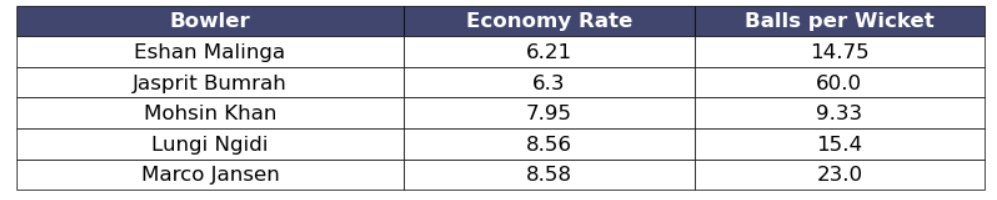
The dipping Ngidi cutter is what we started the article with. But he’s the odd one out here. None of the other four bowlers have needed any dip for their slower balls to be effective.
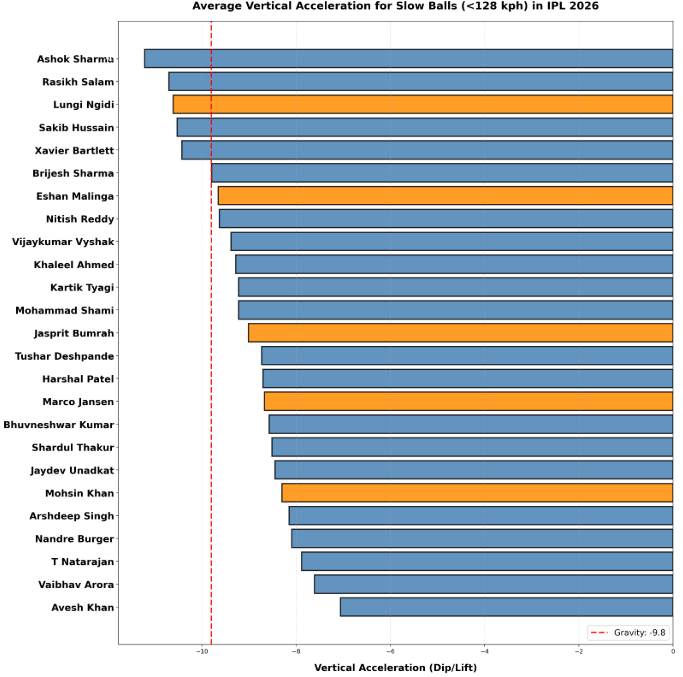
Dip has a negligible effect on economy rate but slower balls with higher dip pose a greater wicket-taking threat. That could explain why Ngidi’s slower balls have a good balls per wicket ratio, even though his economy rate is not as low as some of the others.

It might surprise you that Ngidi doesn’t get the highest dip among all seamers but it’s important to note that the ones ahead of him bowl a back-of-the-hand slower ball, which dips naturally due to forward spin. Ngidi achieves his high dip with an off cutter. Whatever the dip value may be, the surprise element is what troubles batters. A back-of-the-hand slower ball can be picked easily and batters know what trajectory to expect but they aren’t trained to expect that amount of dip from an off cutter.
This is clearly reflected in how his slower balls draw the highest percentage of false shots.
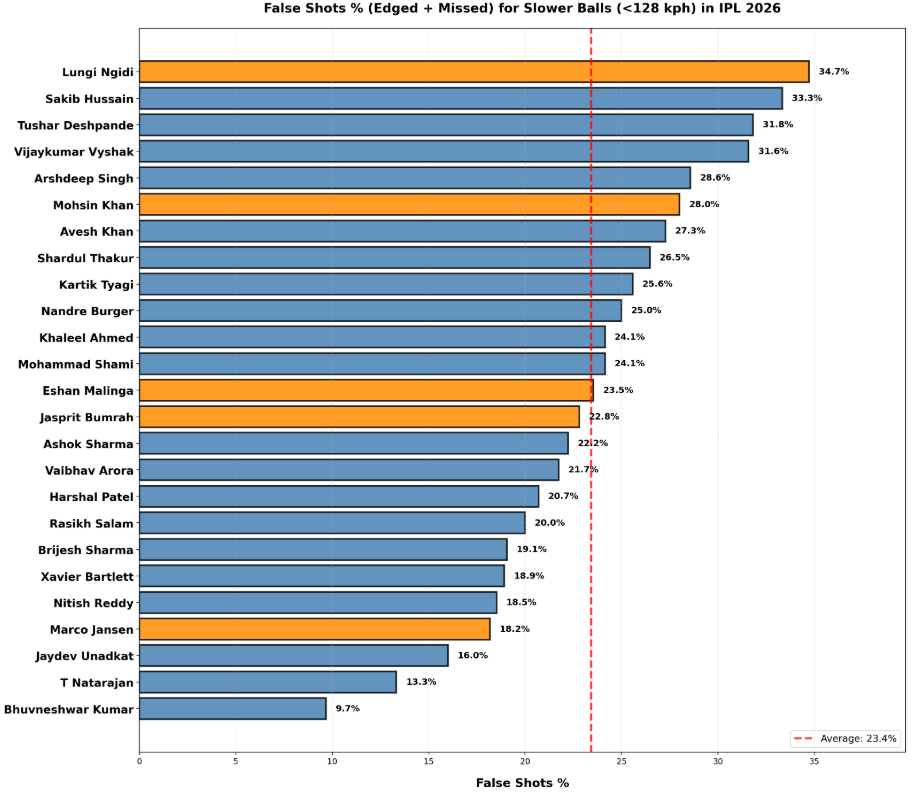
Mohsin Khan also ranks higher in this list, which explains his staggering numbers.
Another area where Ngidi is attacking is in his lengths.
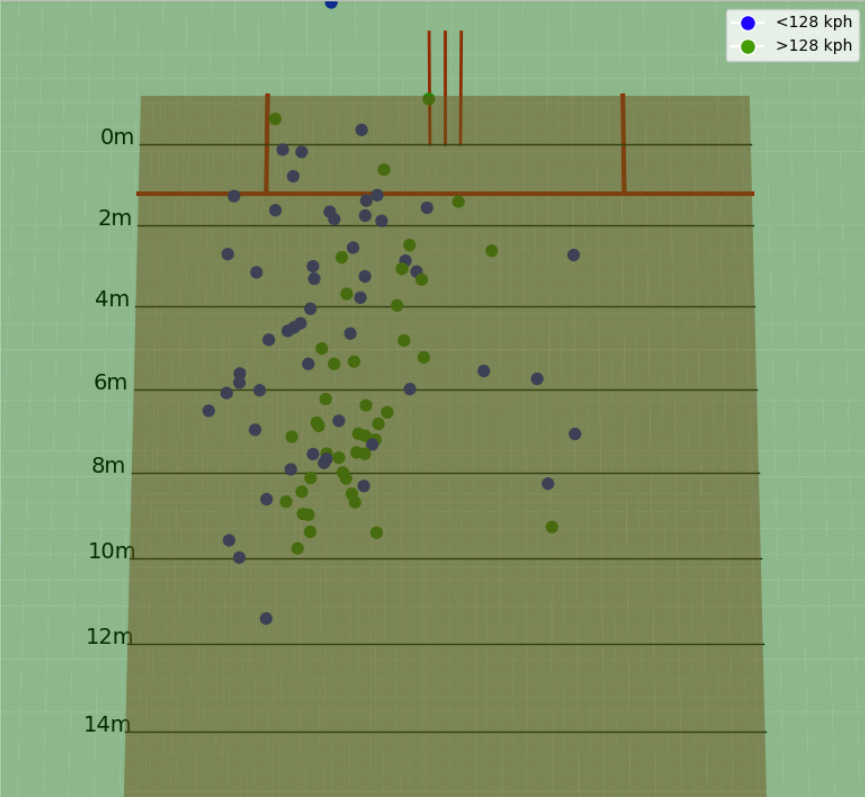
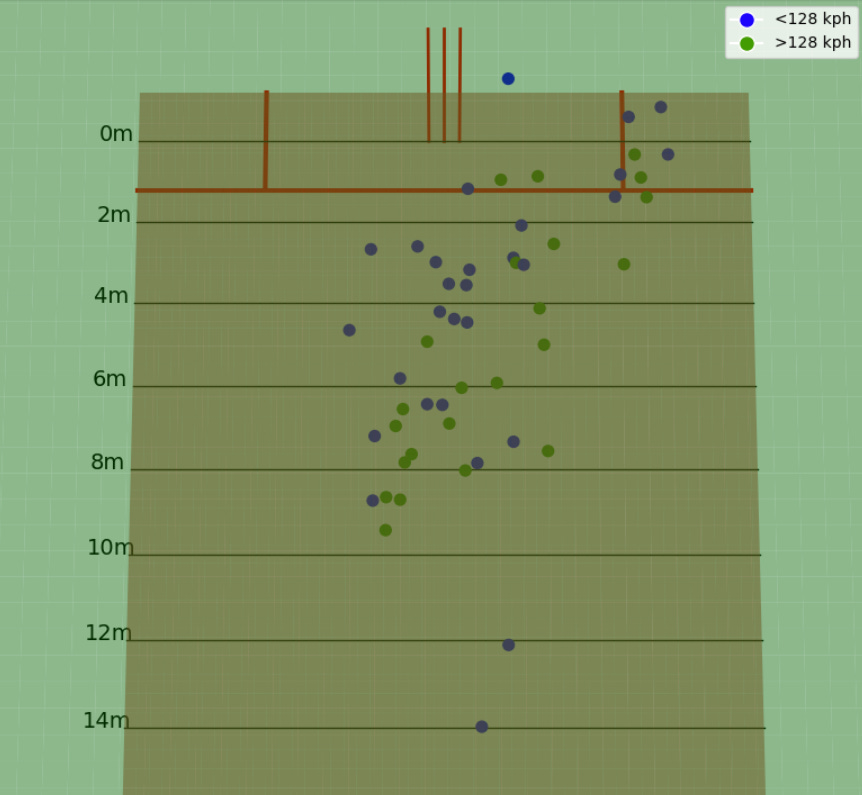
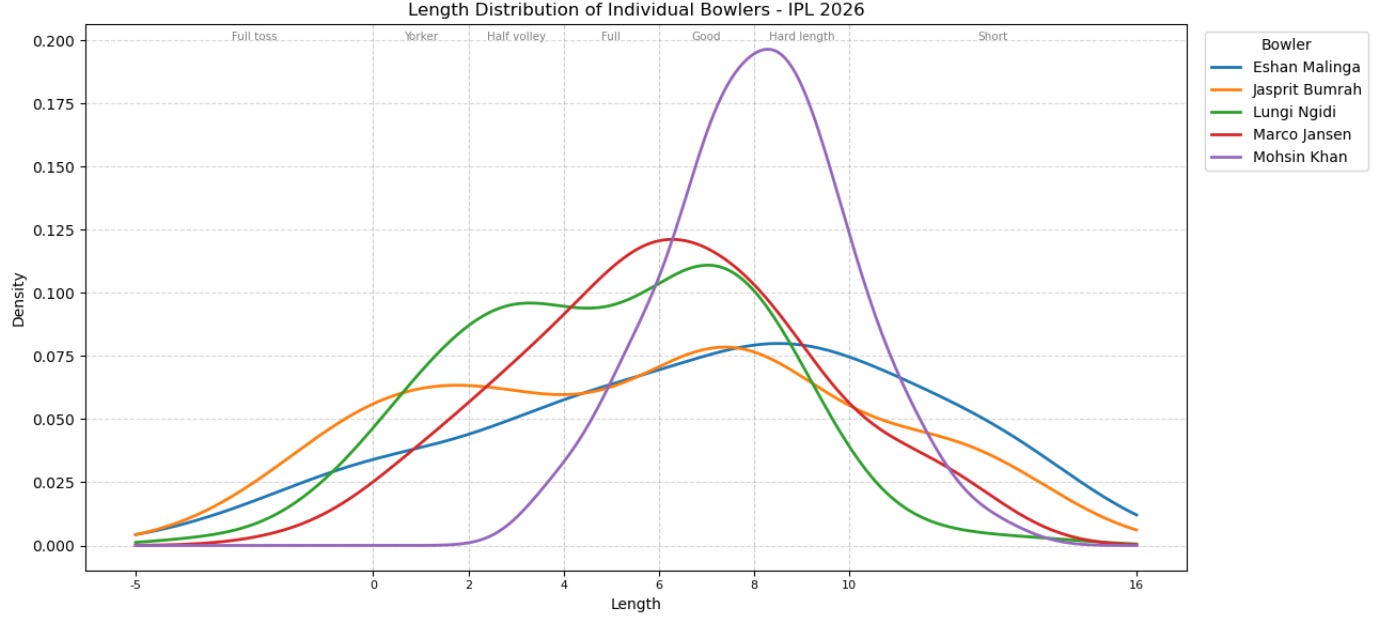
Ngidi is the only one among these five who bowls a higher percentage of his slower balls at fullish lengths.
Slower balls, when bowled fuller, tend to be more expensive but increase the wicket-taking threat as well - a characteristic reflected in Ngidi’s numbers.
On the other hand, Eshan Malinga and Bumrah opt for a more defensive shorter lengths when bowling slower. This explains their lower economy rates.
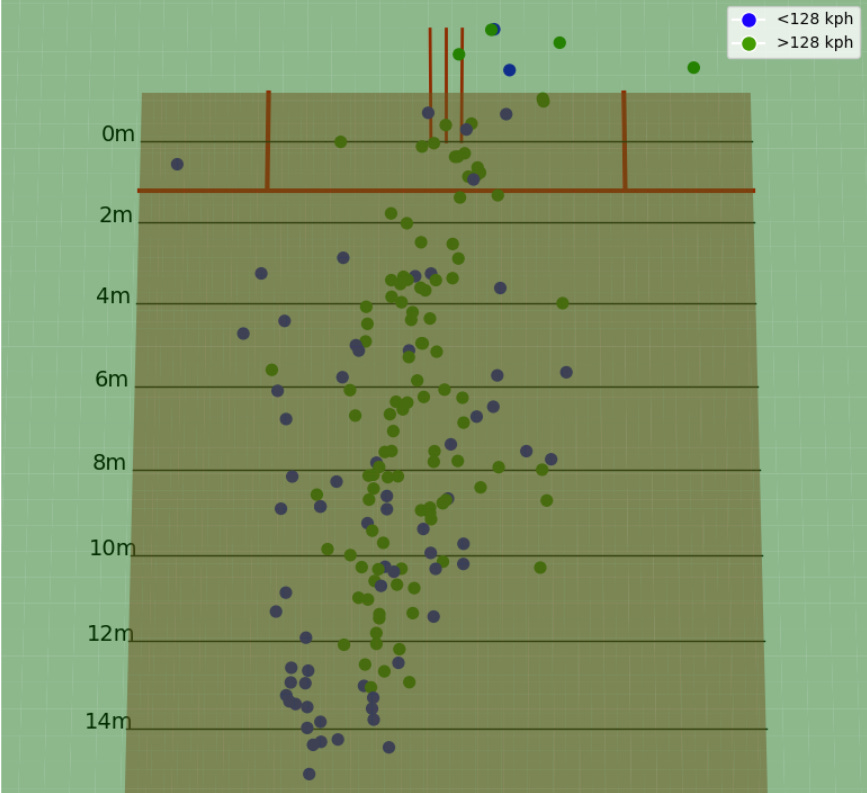
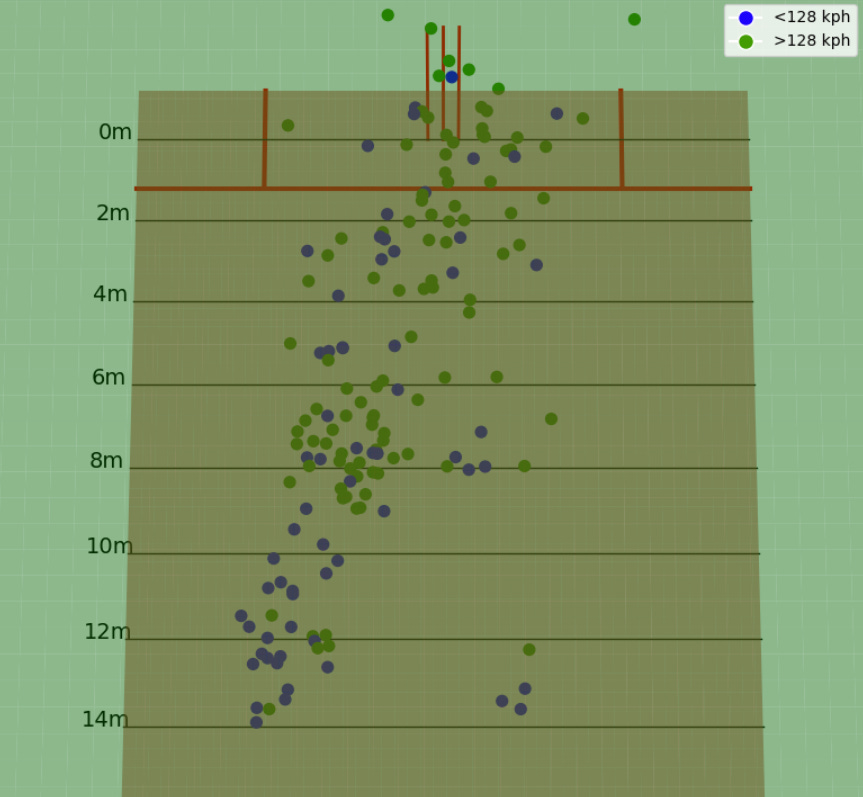
Mohsin and Jansen are interesting in that they don’t have an exclusive length for their slower balls. The length distribution is similar to their stock balls, so there’s no unique characteristic.
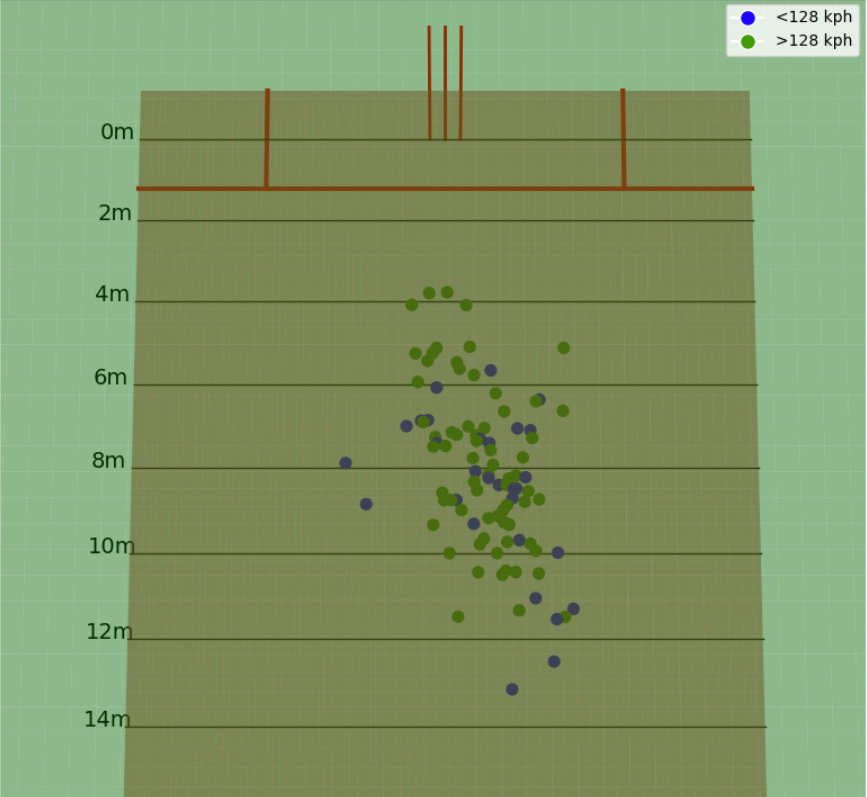
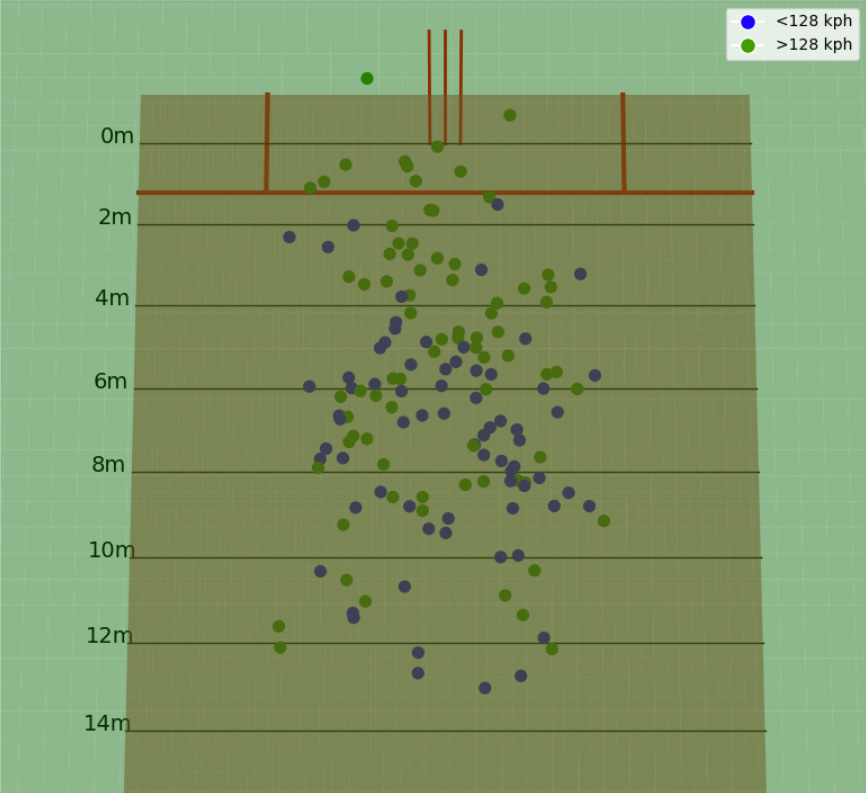
The similarity between the two doesn’t end there. The two tall left-armers also don’t get much grip on their slower balls.
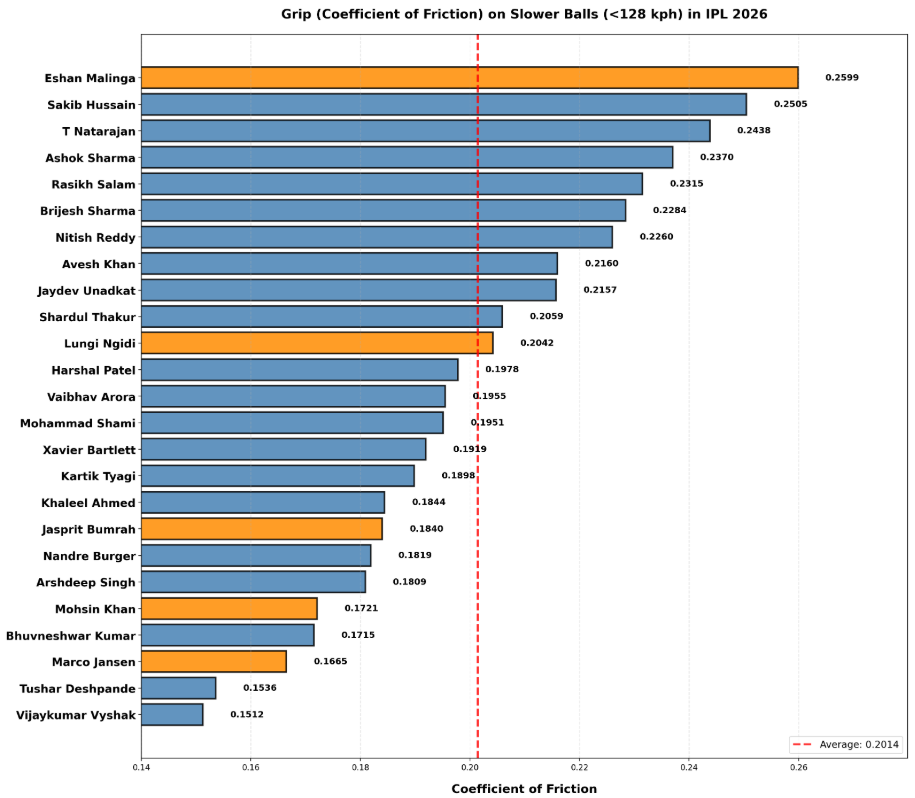
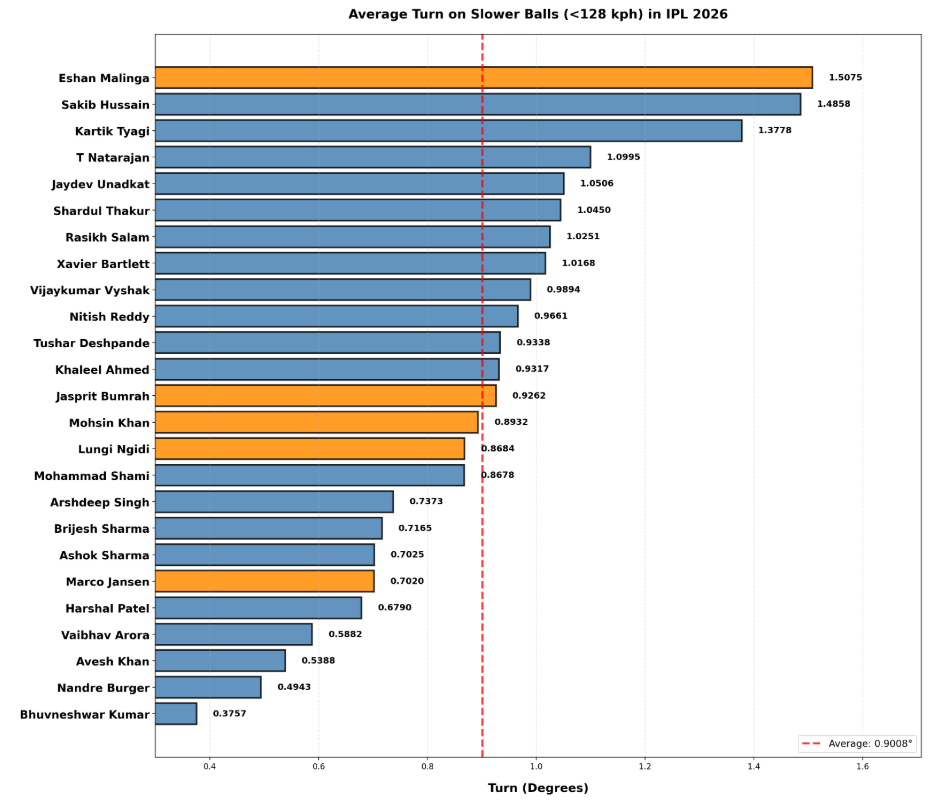
Consequently, they don’t get much turn. Though Mohsin appears slightly better in this regard, he’s still below average.
They fail to extract movement not just off the pitch but also in the air.
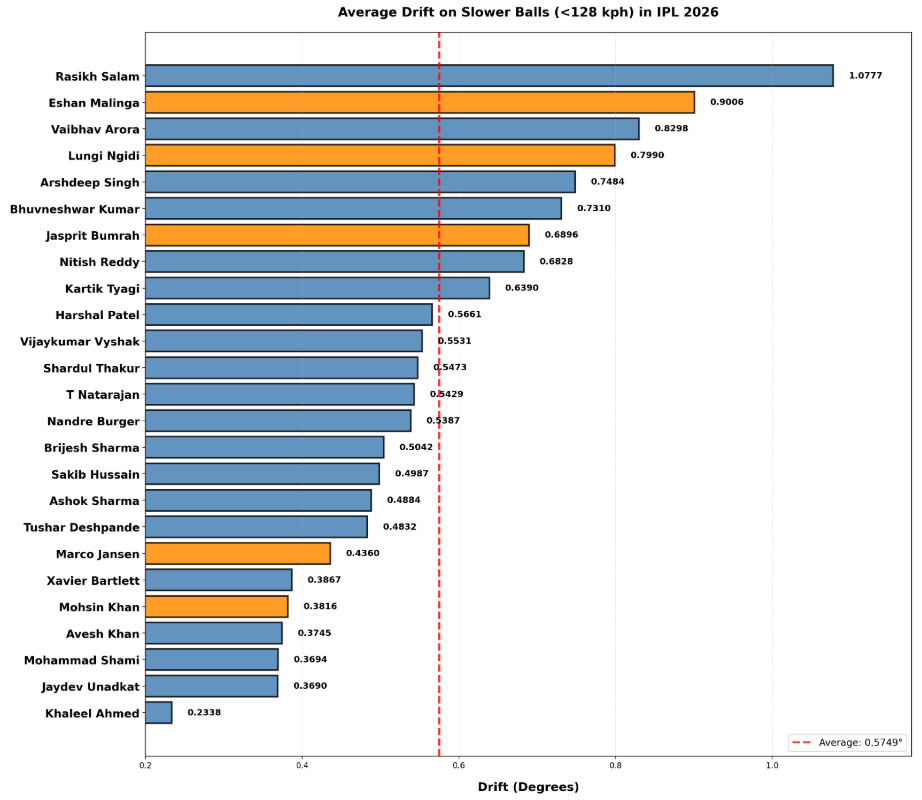
By this point, you would have already noticed Eshan Malinga topping these lists. While he was roughly average for dip and false shots drawn, deviation is his forte. He has been a master at extracting movement - both off the pitch and in the air.
Higher grip is associated with a higher wicket-taking threat and higher drift is associated with a better economy - Eshan gets the best of both worlds. Hence the elite economy rate and balls per wicket on his slower balls.
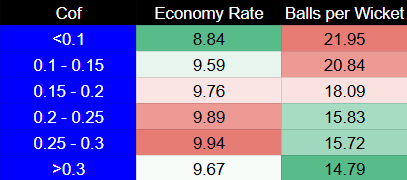
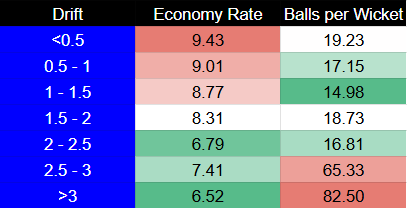
In contrast, Mohsin and Jansen’s lower drift should give them a higher economy and a greater wicket-taking threat. But then the lower grip should balance out that wicket-taking ability. This is visible in Jansen’s record. Mohsin perhaps benefits from being slightly better than Jansen in most metrics and from his insanely disciplined line and length, as his pitch map showed.
Mohsin has the most tightly grouped pitch map of the five. A probability density curve of lengths shows how he’s just been hitting the good and hard lengths like a robot. It’s also amazing how his lines are so tight that he doesn’t even need to change them while bowling to different handed batters.
Jansen is an interesting case though. He ranks among the lowest in almost every metric we considered and doesn’t have any of the generally desired characteristics in his slower balls - doesn’t get dip, draws less false shots, doesn’t get grip, doesn’t move the ball in the air or off the pitch. He doesn’t have a dominant length for his slower balls either, which could have maximised either his economy or his balls per wicket.
But if there’s one metric where he shines, it’s the bounce he gets (you might have expected this) - or the lack of it (I bet you didn’t expect this).
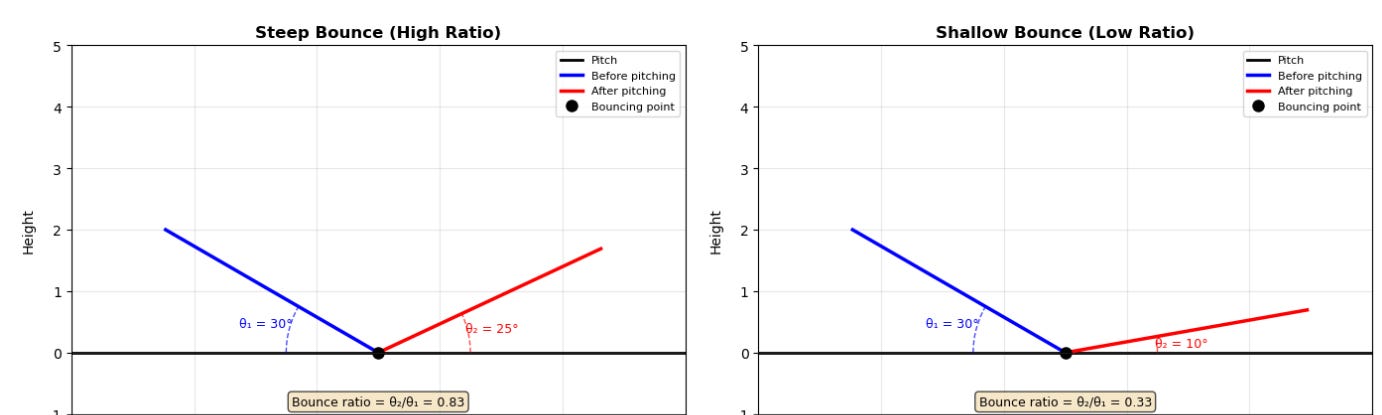
For measuring bounce, we use the ratio between the ball’s angle with the ground after pitching and its angle before pitching. A higher ratio means the ball left the ground at a steeper angle, a lower ratio means a shallower angle.
Data shows that shallower bounce is associated with lower economy while steeper bounce is associated with lower balls per wicket.
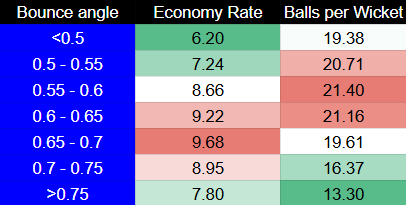
Jansen, with the lowest bounce ratio on his slower balls, possibly gets his lower economy rate from here. This should also introduce a surprise element to batters who wouldn’t expect such low bounce from a tall bowler, which could further improve his numbers.
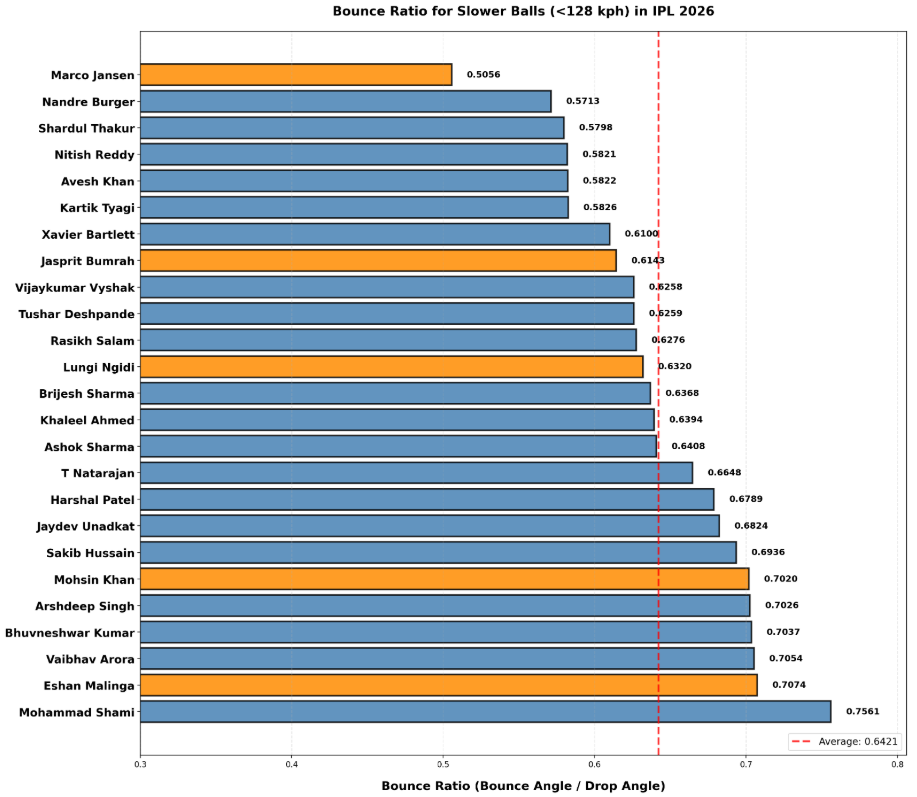
There’s still one bowler we haven’t extensively talked about. Perhaps he’s the one who everyone wants to talk about. Jasprit Bumrah, who is considered an outlier in every sense, is not an outlier in any of the metrics we considered, which in turn made him an outlier in terms of his overall numbers. How poetic!
Bumrah has the weirdest balls per wicket among the five. If you’ve been paying close attention, you would have noticed that he’s about average in everything. He hasn’t got enough dip this season, bowls a defensive length with his slower balls, doesn’t draw enough false shots, doesn’t get enough grip or turn and doesn’t get steep bounce - all of which could have given him a better wicket-taking threat if he possessed them. The only metric where he’s considerably above average is the drift he gets, which also doesn’t help with wicket taking.
An even closer look at the graphs reveals that he’s been below average in metrics where being above average increases your wicket-taking threat. And he’s been above average in metrics where being below average increases your wicket-taking threat. Crazy stuff. No wonder his numbers are crazy too.
In an era where bowlers come up with all sorts of fancy slower ball variations, the ones with the five best economy rates are those who use the most basic version of slower ball variation - the off cutter - as their primary slower ball. Jansen does have a knuckle ball but it is ironic that he manages to release even that as a cutter. You can have all varieties of slower balls but in the end, if you are skilful enough you can be effective even with the most basic version. It doesn’t matter if your definition of slow ball merchants includes them, but they are the ones who really matter because they are the ones who are really effective.
*David Payne, Sandeep Sharma and Shashank Singh were excluded from the analysis their stock balls themselves were already below 128 kph.
All stats presented in this article are accurate as of April 26, 2026.
Data credit: iplt20.com